60+ Web design statistics: Accessibility, AI, and more industry insights for 2026
Share 60+ Web design statistics: Accessibility, AI, and more industry insights for 2026
Explore more from
Design basics
From wireframe to website, faster
Design, prototype, and refine every page.


Design decisions tend to be subjective. Everyone has an opinion, and it’s easy to get stuck debating. Web design statistics help you anchor the conversation in hard data.
To help you make your case, we collected the most relevant statistics shaping modern Web experiences—from mobile usage and AI adoption to the financial ROI of good design. Whether you’re pitching a design overhaul or defending a budget, these numbers help you back up your ideas and build with confidence.
Read on to learn:
- How good Web design affects revenue and conversions
- Benchmarks for UX, accessibility, and performance in 2026
- How AI and new tooling are changing Web design workflows
- Web designer job market statistics
Key takeaways
With a new website launching every few seconds, the competition for attention is relentless. Users rely on fast visuals and consistent branding to filter out the noise. These website statistics underline why a distinct, personalized design is the only way to compete.
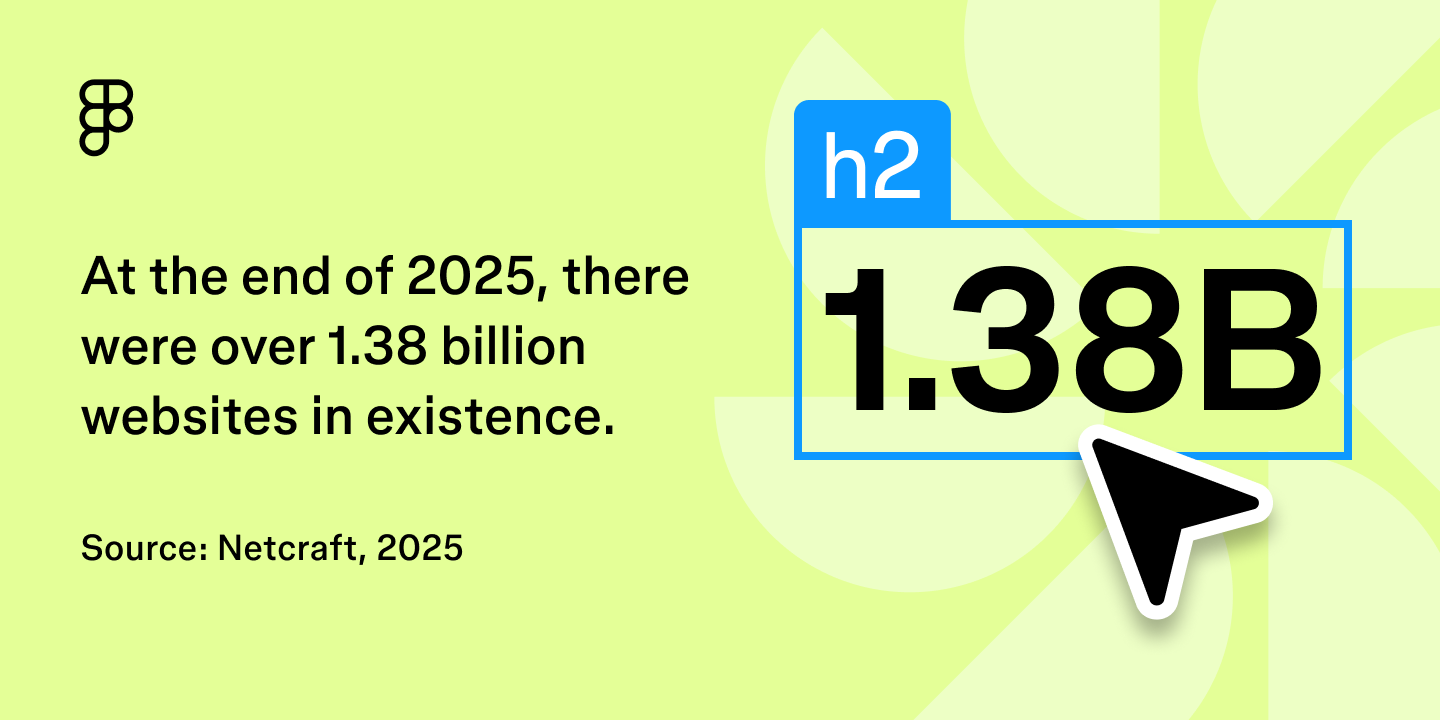
- At the end of 2025, there were over 1.38 billion websites in existence. (Netcraft, 2025)
- A new website launches every three seconds, totaling approximately 252,000 new sites every single day. (Siteefy, 2026)
- Neuroscience research confirms that high-quality visuals are encoded in the human brain 74% faster than text. (Canva, 2025)
- While 71% of consumers expect personalized Web experiences, only 34% of brands are successfully delivering them. (Adobe, 2025)
- The typical homepage is becoming increasingly graphic-heavy, loading an average of 59 separate images per visit. (WebAIM, 2025)
- 78% of customers explicitly state they want consistent brand experiences across all channels. (Adobe, 2025)

Mobile Web design statistics
Mobile devices now drive the majority of online spending, yet soaring bounce rates signal a gap between traffic and usability. Standard responsive Web design is no longer enough. To handle heavier pages and tighter performance expectations, teams need to prioritize mobile-first design.
- Mobile devices accounted for the majority of online spending in October 2025, with a 51.4% sales share, up 11.6% year over year. (Adobe, 2025)
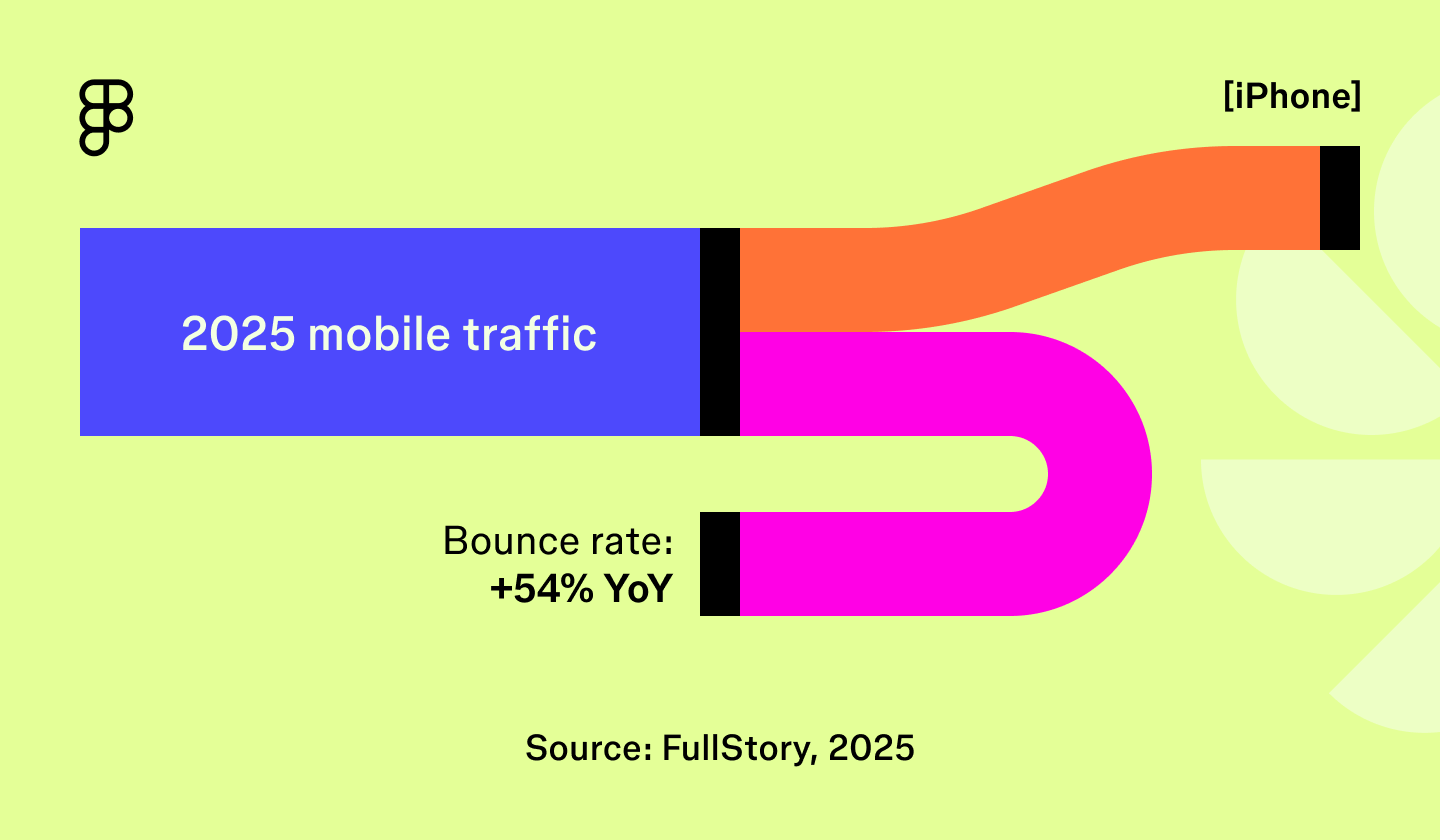
- The average mobile bounce rate rose 54% in 2025, with half of all mobile users exiting after viewing just one page. (FullStory, 2025)
- During Cyber Week 2025, mobile devices accounted for 80% of all digital traffic and 70% of all orders globally. (Salesforce, 2025)
- As of July 2025, the median mobile home page weight reached 2,362 KB—a 202% increase compared to 2015. (HTTP Archive, 2026)
- The median mobile page loads 632 KB of JavaScript, which can significantly slow down average mobile devices. (HTTP Archive, 2025)
- In 2025, 48% of mobile websites achieved a Good score on Core Web Vitals (CWV), showing consistent improvement in recent years. (HTTP Archive, 2025)
- While 51% of the top 1,000 most popular mobile sites have good Core Web Vitals, this drops to 42% for the next 10,000 sites, and further to 37% for the subsequent 100,000 sites. (HTTP Archive, 2025)
- On Christmas Day 2025, customers made 66.5% of all online sales via a mobile device, the highest share of the entire year. (Adobe, 2025)
- By the end of 2025, 5G networks accounted for an estimated 43% of all mobile data traffic, enabling richer media experiences on mobile. (Ericsson, 2025)
- 5G subscriptions reached approx. 2.9 billion by late 2025, accounting for one-third of all mobile subscriptions worldwide. (Ericsson, 2025)
- During the peak 2025 shopping season, customers made 25% of all purchases using a mobile wallet (e.g., Apple Pay, Google Pay). (Salesforce, 2025)
- To optimize rendering and design, 41.3% of mobile websites used variable fonts in 2025. (HTTP Archive, 2025)
- As of December 2025, the most common mobile screen resolution worldwide is 360x800. (Statcounter, 2025)

Accessibility in Web design statistics
Businesses often treat accessibility as an afterthought, which can become both a legal and strategic mistake. These statistics show that learning how to design for accessibility protects your business and expands your audience.
- As of February 2025, 94.8% of the top 1 million homepages failed to meet WCAG accessibility standards. (WebAIM, 2025)
- The average number of detectable accessibility errors per homepage has dropped by 10.3% year-over-year since 2024. (WebAIM, 2025)
- Low contrast text is the most persistent accessibility flaw, affecting 79.1% of homepages in 2025. (WebAIM, 2025)
- The average homepage in 2025 contained 1,257 elements, up 7.1% from 2024, contributing to increased interface complexity. (WebAIM, 2025)
- Despite ARIA (Accessible Rich Internet Applications) usage growing nearly 5x since 2019, pages using it averaged twice as many errors in 2025 than those without. (WebAIM, 2025)
- Government websites led in compliance with only 19.6 errors per page, whereas Shopping and News sites lagged significantly, averaging 71.2 and 59.8 errors, respectively. (WebAIM, 2025)
- In 2024, plaintiffs filed lawsuits against over 1,000 businesses that had an accessibility widget or overlay installed. (UsableNet, 2025)
- Since 2018, 82% of the top 500 e-commerce retailers have faced an ADA-related digital lawsuit. (UsableNet, 2025)
- Only 28% of organizations begin addressing accessibility during the planning phase, and only 27% during the design phase. (Level Access, 2025)
- With the EAA enforcement starting in June 2025, 76% of organizations say the law applies to them, yet only 37% report being fully compliant as of late 2025. (Level Access, 2025)
- 70% of the U.S. population now stands to benefit from accessible technology (due to aging, neurodiversity, or situational limits), up from 57% in 2003. (Forrester, 2025)
- Organizations with “highly supportive” executives are 7x more likely to see revenue gains from their accessibility programs compared to those with low support. (Level Access, 2025)
Web designer job market statistics
We’ve all seen the headlines about AI coming for creative jobs. But the numbers show that Web design isn’t going anywhere.
Demand is simply moving toward new, specialized roles, with steady growth expected over the next decade. As the data below shows, the outlook is strong for designers willing to adapt.
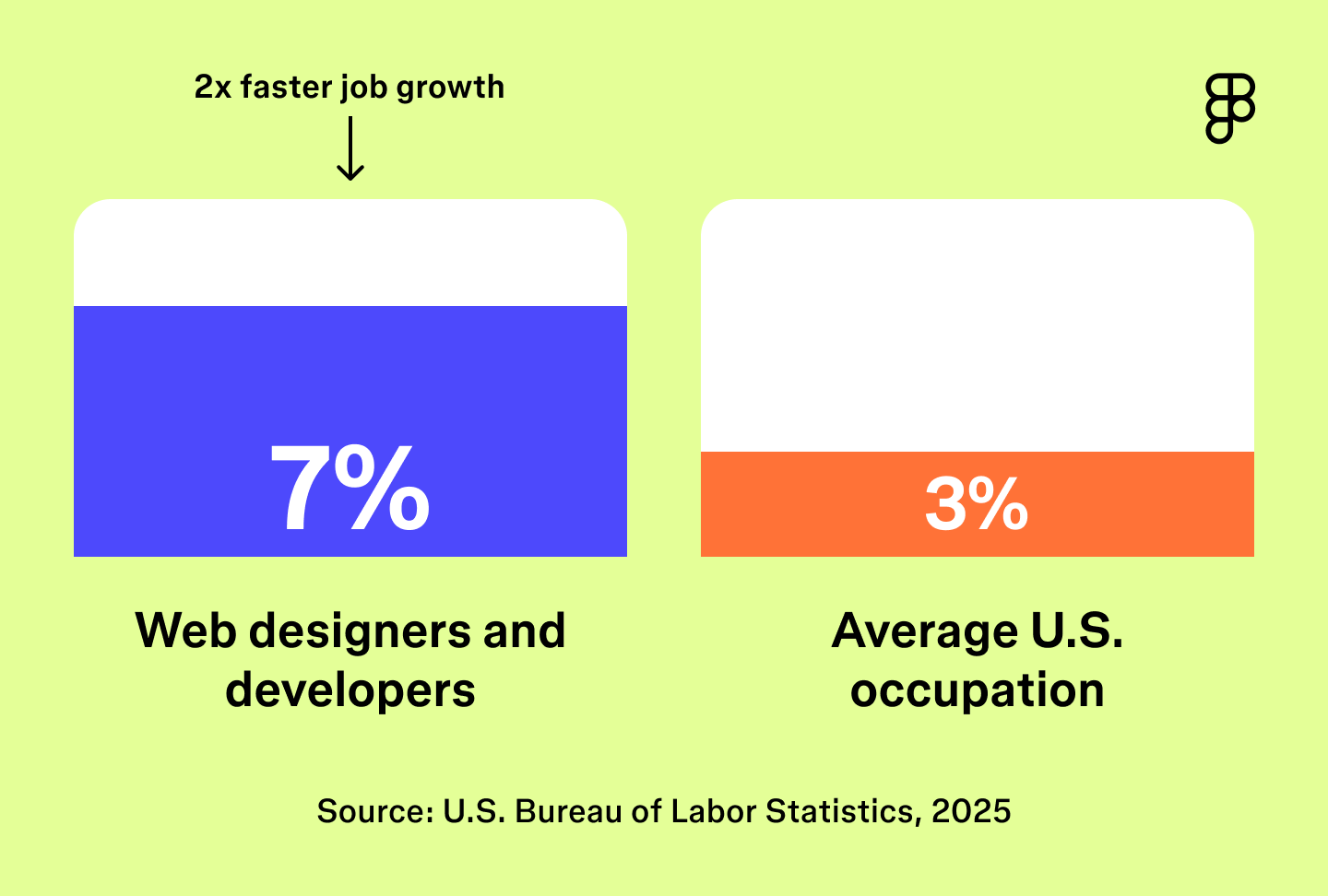
- Employment for Web developers and designers is projected to grow 7% from 2024 to 2034. (U.S. Bureau of Labor Statistics, 2025)
- The U.S. market is expected to see roughly 14,500 job openings for Web designers and developers each year over the next decade. (U.S. Bureau of Labor Statistics, 2025)
- The global Web design services market reached a valuation of $61.23 billion in 2025. (Mordor Intelligence, 2025)
- Internationally, the Web design and development sector is experiencing approximately 9% annual growth in job postings as of 2025. (Web Professionals Global, 2025)
- The median annual wage for Web designers reached $98,090 in mid-2024. (U.S. Bureau of Labor Statistics, 2025)
- In the marketing and creative sector, 14% of roles are fully remote, 30% are hybrid, and 56% are fully on-site as of the end of 2025. (Robert Half, 2026)
- 74% of executives hiring in 2025 stated that college degrees are irrelevant when vetting freelancers, prioritizing proven expertise instead. (Upwork, 2025)
- Privacy-First Designer and Sustainable Web Developer have emerged as distinct, high-demand job titles in 2025. (Web Professionals Global, 2025)

Build a website, no code required
Figma Sites lets you design, prototype, and ship responsive websites without writing a single line of code.
AI Web design statistics
AI is dominating Web design trends as a practical tool for research and asset generation. Teams use it to speed up workflows, iterate faster, and personalize user journeys. Yet, evidence shows that human judgment is still the difference between a rough draft and a polished product.
- 34% of designers and developers reported shipping an AI product in 2025, a significant jump from 22% the previous year. (Figma, 2025)
- 56% of Figma users say their companies are actively integrating AI into existing products, while 43% are building entirely new AI products. (Figma, 2025)
- The share of agentic AI projects doubled from 21% to 51% in 2025. (Figma, 2025)
- Only 69% of designers are satisfied with current AI tools, citing a lack of precision and quality control in AI-generated UI. (Figma, 2025)
- In the discovery phase, 40% of designers use AI to analyze data, and 38% use it to conduct desk research, signaling a shift in how teams kick off projects. (Figma, 2025)
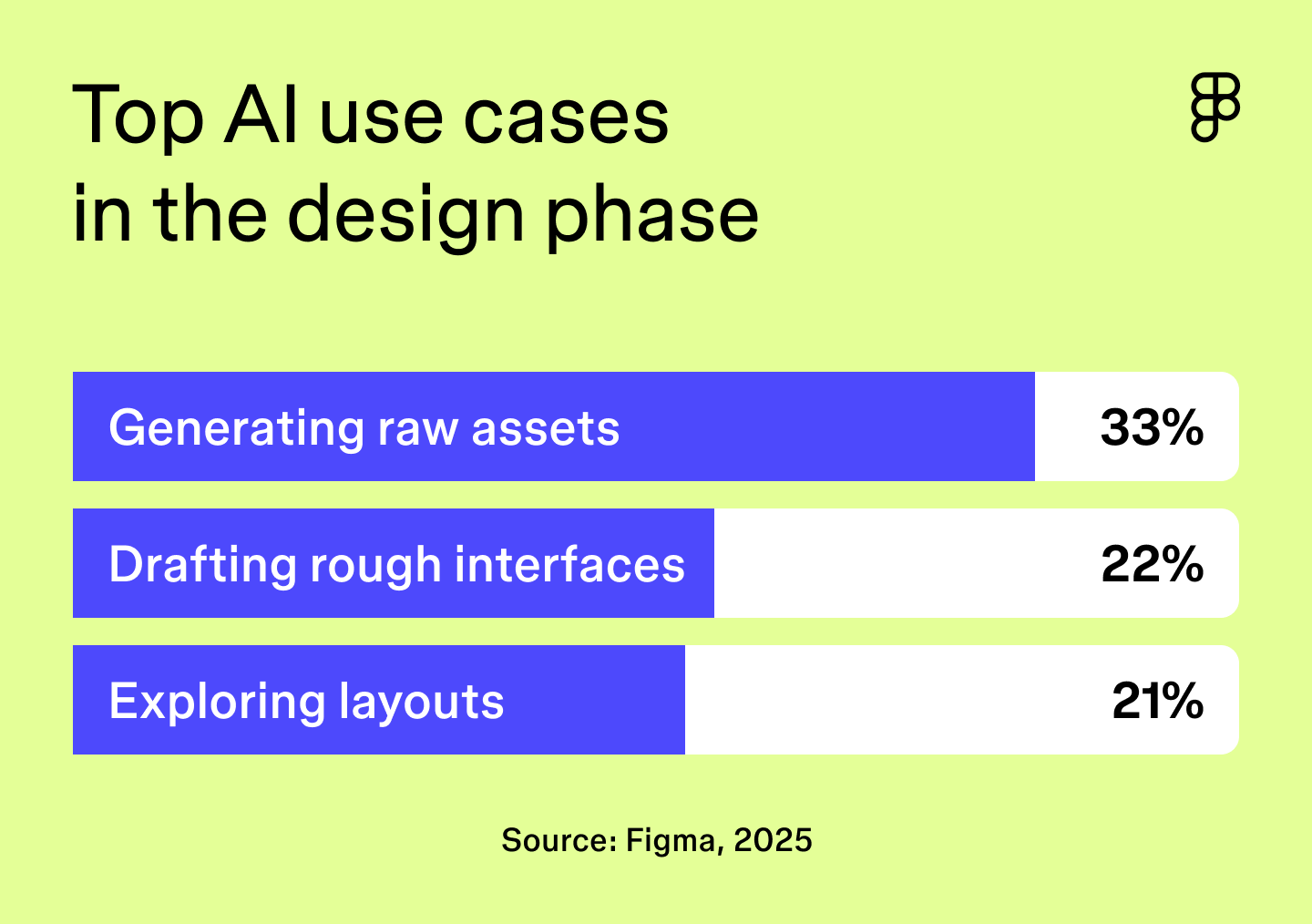
- In the design phase, 33% use AI to generate raw assets, 22% to create rough interface drafts, and 21% for layout exploration. (Figma, 2025)
- While efficiency is up, only 40% of designers feel AI improves their work quality. (Figma, 2025)
- 92% of marketing and creative leaders believe that AI literacy will be a mandatory skill for professionals within the next two to four years. (Canva, 2025)
- 85% of creative leaders report they reclaim at least four hours per week by using AI tools in their workflow. (Canva, 2025)
- Despite high adoption, 94% of designers and marketers still carefully review and refine AI-generated outputs to ensure brand consistency and safety. (Canva, 2025)
- 27% of organizations are using generative AI to personalize images, infographics, and video content. (Adobe, 2025)
- In the retail sector, 43% of organizations are investing in “automated content assembly” to dynamically build Web pages and app interfaces that meet real-time demand. (Adobe, 2025)

ROI of thoughtful Web design
Design builds the credibility needed to turn visitors into buyers. With Web design costs rising and attention spans shrinking, you simply can’t afford to lose traffic to a clunky experience. These numbers make the case for investing in good design.
- 52% of consumers in 2025 reported stopping their use of a brand entirely after a single bad experience with its products or services. (PwC, 2025)
- Overall website conversions dropped by 6.1% in 2025. (Contentsquare, 2025)
- The cost to acquire a single website visit jumped by 9% in 2025, making the ROI of every landing page design critical to offsetting acquisition costs. (Contentsquare, 2025)
- 75% of organizations report that accessibility directly contributes to improved revenue. (Level Access, 2025)
- Websites that actively minimized user frustration (e.g., rage clicks, slow loads) in 2025 saw 4.5x less visitor churn than those that ignored these signals. (Contentsquare, 2025)
- Designs that successfully encourage users to view just 10% more content (session depth) see a corresponding 5.4% increase in conversion rates. (Contentsquare, 2025)
- Rage clicks (rapidly clicking an element out of frustration) increased significantly in 2025, particularly on Product Detail Pages and filters. (FullStory, 2025)
- Companies that invest in validated user research and usability testing are 1.9x more likely to report improved customer satisfaction scores than those that rely on guesswork. (Maze, 2025)
- The average large-sized e-commerce site can gain a 35.26% increase in conversion rate solely through better checkout design. (Baymard Institute, 2025)
Frequently asked questions
How can I make my website more accessible?
Start by using semantic HTML so that screen readers can interpret your website structure. Maintain high color contrast for readability and always provide descriptive alt text for images. Finally, test your site using only a keyboard to catch navigation errors that automated scanners miss.
How much does Web design really affect conversions?
Design is often the deciding factor in whether a visitor converts. Users judge credibility based on visual appeal instantly. If your site looks cluttered or confusing, they lose trust and leave before reading a single word. Good design clears the path, making it effortless for customers to move from browsing to buying.
Can I design a website with AI?
Yes, you can use AI to create a website or generate wireframes in seconds. But it works best as a starting point—you still need to refine the output to ensure it matches your brand and solves user problems effectively.
Is the Web design industry growing?
Yes. Web design industry statistics show that employment will continue to grow over the next 10 years. The market is also expanding financially, with the global Web design market projected to reach $61.23 billion in 2025. While tools change, the data confirms that demand for skilled professionals remains strong.
Elevate your next Web design project with Figma
The data speaks for itself. Modern websites must be fast, accessible, and mobile-first. We hope these Web design statistics help you make the case for better design. When you’re ready to put them into practice, we’d love for you to try Figma.
Here’s how Figma can help:
- Use Figma Sites to go from design to live Web experiences without code.
- Collaborate with developers via Dev Mode and AI‑assisted code generation.
- Create flexible mobile-first design and responsive website layouts using Figma’s UI design tool.
- Improve workflow efficiency by mapping out processes and brainstorming ideas in FigJam before starting on Web design.
Ready to design what’s next?
Figma facilitates cross-team collaboration so devs and designers can build better sites faster.
Keep reading


How to use AI to create a website
Learn how to use AI to create a website from start to finish. Discover tools, tips, and strategies to design, build, and launch your site faster than ever.


Website structure: How to plan the perfect site layout
A website structure is the layout and design of your site pages. Learn how to create the perfect structure for your website with Figma.