How to write SMART goals (+ expert examples and tips)


Share How to write SMART goals (+ expert examples and tips)
Explore more from
Team productivity


Whether you’re launching a new feature or planning a career pivot, you probably have short- and long-term goals—professionally and personally. But where do you start with a plan to achieve them?
One smart move is to define your goals clearly. The SMART framework helps you set goals that are specific, measurable, attainable, relevant, and time-bound.
Read on to discover:
- What SMART goals are and how to write them
- Why SMART goals work
- Examples of what they look like
- Tips for setting SMART goals
What is a SMART goal?
George T. Doran introduced the SMART goal framework in 1981, writing, “There’s a SMART way to write management goals and objectives.”
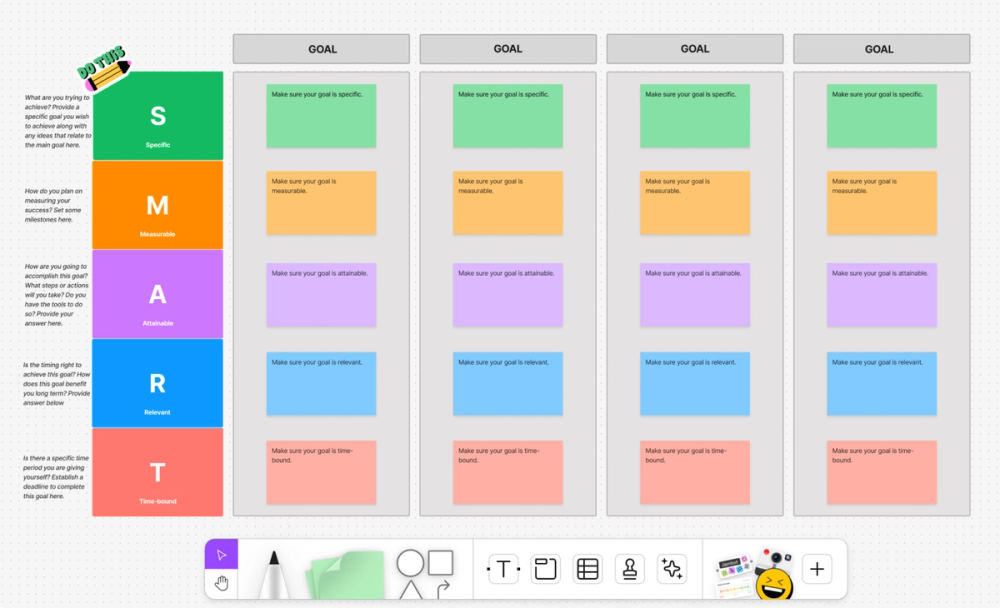
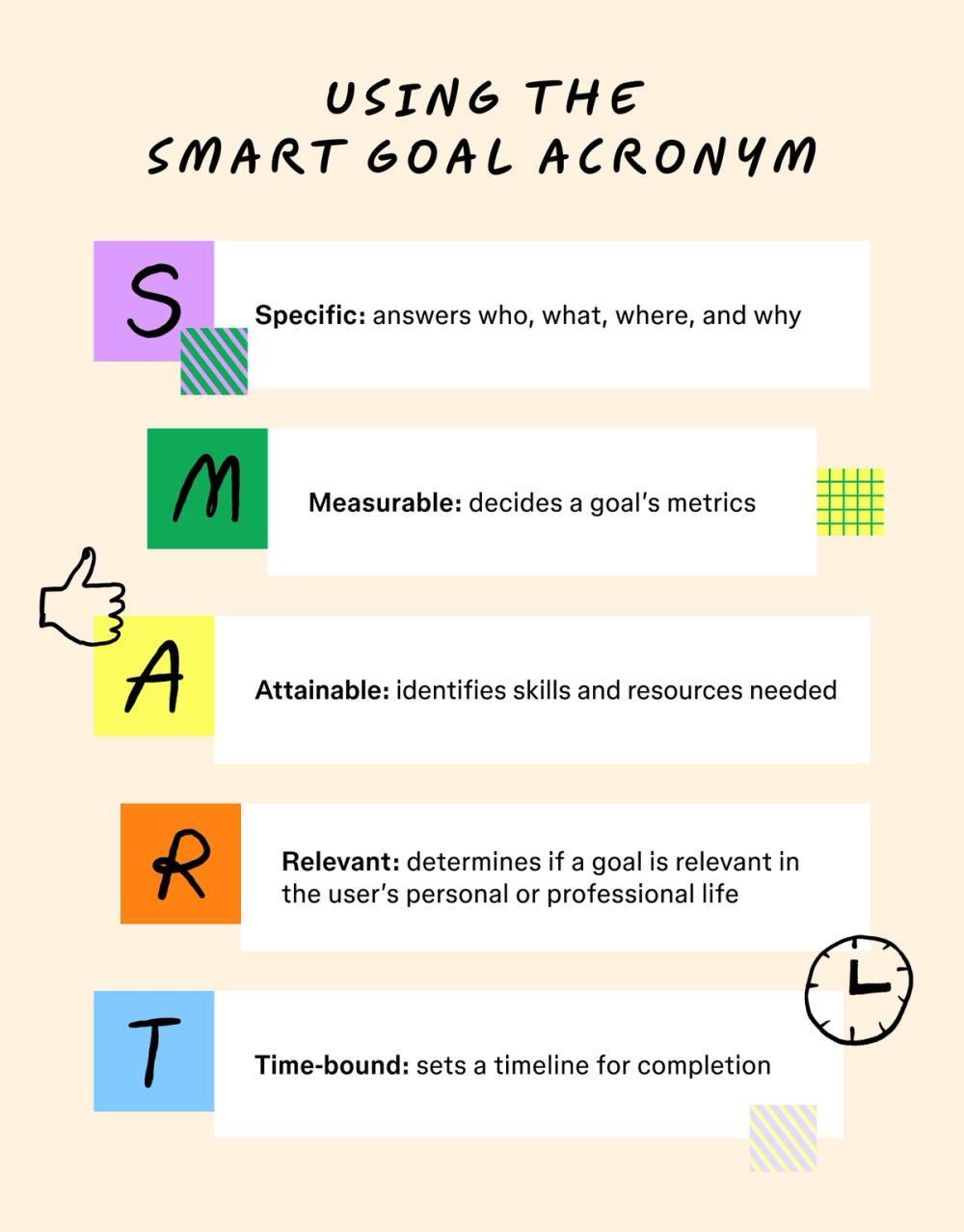
Since then, it’s become a go-to tool for setting both personal and professional goals. Here’s what SMART stands for:
- Specific: Target a specific area for improvement.
- Measurable: Define the metrics you use to gauge goal progress.
- Attainable: Objectives match your skill level and resources.
- Relevant: Goals directly apply to your work, life, and available tools.
- Time-bound: Create a deadline to achieve the goal.

Why do SMART goals matter?
SMART goals help you clarify objectives and key results (OKRs) and avoid pitfalls like vague plans or procrastination. Getting into the details can make a big difference.
Locke’s goal-setting theory, first introduced in the 1960s, found a positive relationship between clearly identified goals and performance. The SMART goal framework gives you a structured way to turn ideas into focused, achievable action.
How to write a SMART goal
Say your goal is to increase your organization’s revenue. That’s a solid star, but how will you do it? Do you have the resources? How much more revenue are you aiming for?
Broad goals become more achievable if you define the details using the SMART framework.

Specific
Start by making your goal specific. In our example, decide how you’ll bring in more revenue. Use the “W” questions to refine the details:
- Who should be involved for the goal to succeed? Consider the teams, stakeholders, and partners who will help you reach your goal.
- What do you want the end result to be? Use as much detail as possible to show the importance of this objective.
- Where will you reach your goal? This question only applies to goals completed at a certain event or in a specific area.
- Why does this goal matter? Think of this question as a defense or justification of your objective.
Example: You should aim to boost your year-over-year revenue by 5%.
Measurable
Once your goal is specific, choose how you’ll measure success. Tracking clear metrics—and breaking larger goals into milestones—helps you spot progress, delays, or momentum early.
Example: You should regularly meet with sales and product managers about your problems and opportunities. Within three months, check your product improvements or new sales leads to see if you’re on track to boost earnings.
Attainable
To see if a goal is attainable, ask what knowledge, skills, or tools you’ll need. You may have to learn something new, or rethink the timelines so the goal stays realistic.
Example: Based on industry research, similar businesses improved their revenue by 5% year-over-year. So, research their methods and see if you have the tools to replicate their success.
Relevant
For professional goals, make sure your objectives align with company-wide priorities. The more clearly you connect your SMART goals to team and business impact, the more it will motivate your teams.
Example: Improving your company’s bottom line helps everyone involved. Higher revenue boosts dividends, gives your employees more job security, and offers leaders the funding to invest in new strategies.
Time-bound
Every goal needs a timeline. Setting realistic deadlines and checking in along the way creates urgency, momentum, and a path to steady progress.
Example: Your company’s revenue year-over-year should improve by at least 5% within two years.
Start setting smarter goals with FigJam.
Use FigJam templates to set goals within minutes.
SMART goal examples
SMART objectives organize your business, team, and personal goals. Here are a few examples that explain the SMART goal-setting process.
Job performance SMART goal
The SMART goals framework can help you turn a vague goal into a more specific and actionable objective.
General goal: “I want to improve my professional performance.”
- S. Currently, I am underperforming compared to my peers. I have not made as many sales as others in my position, and my contacts are of a lower caliber. I would like to improve my performance so it’s comparable to my team.
- M. I will measure my performance by the number of sales I can complete before my subsequent evaluation.
- A. To improve my professional skills, I will invest in industry-specific training and contact my supervisors about potential skill labs and shadowing opportunities.
- R. Sixty percent of my job is completing sales. As the success of our company relies on consistent sales and renewals, this goal is incredibly relevant to our company’s bottom line.
- T. I would like to see improvement by my next review period.
SMART goal: To grow my professional skills and positively impact my company, I want to invest in online or in-person training to increase my sales by 5% by my next review period.
- Milestone: Complete a sales training course within three months
- Deadline: The upcoming review period in six months
Financial SMART goal
If you’re stressed about money, SMART goals can provide clearer guidelines for saving money and achieving better financial security.
General goal: “I want to save more money.”
- S. I save only 5% of my monthly income and want to build a stronger emergency fund. My goal is to increase my savings rate to 20% of my gross monthly income.
- M. I will track my monthly savings amount and percentage of income saved. Success means consistently saving $800 per month (20% of my $4,000 monthly income).
- A. I can reduce my spending on dining out, impulse purchases, and negotiate better rates for subscriptions.
- R. Building an emergency fund is essential and will reduce stress about unexpected expenses.
- T. I want to establish this new savings habit within six months.
SMART goal: To achieve greater financial security, I’ll increase my monthly savings from 5% to 20% of my income within six months by creating a detailed budget, reducing dining expenses by $300 monthly, creating a specific fund for impulse purchases, and automatically transferring $800 to my savings account each payday.
- Milestone: Reach a 12% savings rate within three months
- Deadline: Six months
Product development SMART goal
Product development can be a drawn-out process. Some delays are inevitable, but with SMART goals and planning strategies like swimlane diagrams, your team can avoid common time sucks and finish their projects on time.
General goal: “We want to launch a new product feature.”
- S. Based on user feedback, our mobile app needs a dark mode feature to improve user experience (UX). Sixty percent of active users have requested this feature in recent surveys.
- M. We’ll measure success by feature completion, user adoption rate, and user satisfaction scores for the new feature.
- A. Our development team has experience with UI/UX design changes, and we have allocated development resources for this quarter.
- R. This feature addresses a top user request and aligns with our goal to improve user retention and app engagement.
- T. We plan to complete development, testing, and launch within eight weeks.
SMART goal: To improve UX and increase app engagement, we will design, develop, test, and launch a dark mode feature for our mobile app within eight weeks, achieving 40% user adoption within the first month, increasing the time spent on the app for users by 10%.
- Milestone: Complete design mockups and user testing within four weeks
- Deadline: Eight weeks
Interpersonal SMART goal
Team SMART goals help your team collaborate on a shared objective. They can draw from company-wide objectives or needs specific to the team members you work with.
General goal: “We want to increase team collaboration.”
- S. Our team members work apart instead of forming a unified group. To increase productivity and cooperation, we’ll create a welcoming environment that improves collaboration across all projects.
- M. About 50% of our projects should include some form of collaboration. We would like to see a 25% increase in collaboration to make this goal a success.
- A. Our department encourages teamwork with collaborative workspaces available.
- R. Department and company goals focus on increased collaboration and co-branding opportunities.
- T. Our team should see improvement in six months.
SMART goal: To increase team collaboration and cooperation, include collaborative work in at least 25% of department projects within six months.
- Milestone: Complete two team-building activities before the next quarter begins.
- Deadline: Within six months
Learning and development SMART goal
Some people struggle to focus on learning new skills, especially with busy professional and personal schedules. Writing SMART goals can keep you accountable with clear goals and timelines.
General goal: “I want to get a promotion at work.”
- S. I need to stay current and grow my Web design skills to include prototyping to prove to my manager I’m ready for a promotion.
- M. I will complete a prototyping course, completing two prototyping projects on Figma to add to my portfolio.
- A. My company offers access to Figma and a learning stipend, which I can use to attend a bootcamp.
- R. If I master prototyping, I will be able to work on projects that have a larger impact at my company, build more experience, and earn a promotion.
- T. I’d like to complete two expert prototype sample projects in six months.
SMART goal: To advance my expertise and support my career, I will take a software prototyping course with classes after work. I plan to master prototyping on Figma in four months and complete two sample projects in six months.
- Milestone: Master prototyping on Figma in four months
- Deadline: Six months
Personal SMART goal
You can set personal SMART goals for almost anything. Let’s turn a broad exercise goal into a specific and measurable fitness objective.
General goal: “I want to run faster.”
- S. I run approximately once a week and have seen little to no improvement in my times. By the end of this goal, I would like to decrease my mile time by ten seconds.
- M. While I can compare mile times week by week, I should track additional metrics for this goal. Mileage should increase by 5% each week, and my stride turnover should increase each month.
- A. My goal to reduce my mile time over a year will allow my body to adjust to this increased physical activity level and build up my stamina safely.
- R. Physical fitness is important to me, and running consistently can improve my health.
- T. I should see changes within one year.
SMART goal: To decrease my mile time, I will focus on exercises that improve endurance. I will increase my weekly mileage by 50%, run up stairs until I can do so for one minute straight, and train approximately four to five times per week. Within a year, I should decrease my mile time by 15 seconds.
- Milestone: Increase weekly mileage by 25% within six months of training
- Deadline: One year
Marketing SMART Goal
There are many different ways to approach marketing goals, so the SMART method effectively streamlines strategy.
General goal: “We want to increase our social media presence.”
- S. Our cosmetics company’s social media engagement isn’t as robust as our top competitors’. We need to increase followers and engagement and improve brand awareness on TikTok.
- M. We’ll track follower growth, likes, and comments. We’d like to gain 2,000 more followers and increase our average likes and comments per post by 10%.
- A. Our marketing team has experience with social media. We also have the budget for content creation tools and paid promotion.
- R. Improved social media presence directly supports brand awareness and can drive more purchases.
- T. We aim to achieve these results within six months.
SMART goal: To strengthen our brand presence, we will increase our TikTok engagement rate by 10% and earn 2,000 new followers within four months. We’ll achieve this by posting daily content, running two targeted ad campaigns monthly, and collaborating with three industry influencers.
- Milestone: Earn 1,000 new followers and increase engagement rate by 5% in three months
- Deadline: Six months
Customer service SMART goal
Customer service performance can be volatile as teams learn new processes, tools, and standards. SMART goals can align the department for more consistent performance and growth.
General goal: “Our team wants to improve customer satisfaction.”
- S. Our customer satisfaction scores have dropped to 3/5 stars, and customers note they find inconsistent responses as our team handles their tickets. We’ve grown the team significantly and struggled to train new hires efficiently. We need to standardize our processes to improve the customer experience.
- M. We will track customer satisfaction scores and first-call resolution rates. Our target is to achieve 4.5/5 stars and improve first-call resolution rates by 5%.
- A. We have training resources and management support to provide additional team training and create a consistent pathway for representatives to make decisions while communicating with customers.
- R. Better customer service directly impacts customer retention, which is crucial for our subscription-based business model and revenue growth.
- T. We expect to see significant improvement within nine months.
SMART goal: To enhance customer loyalty and reduce churn, our customer service team will improve our satisfaction rating from 3 to 4.5 stars within three months by implementing standardized response protocols and conducting weekly team training sessions.
- Milestone: Achieve a 4-star average rating within six months
- Deadline: Nine months
Health and wellness SMART goal
Many people only create health goals on New Year’s Day, and let’s face it, forget about them by February. With planned check-ins and milestones, SMART goals can turn a health goal into a habit.
General goal: “I want to get better sleep.”
- S. I currently sleep an average of five hours per night and frequently feel tired during the day. I want to establish a consistent sleep schedule and improve sleep hygiene to achieve seven or more hours of sleep at least five times a week.
- M. I will track my sleep duration and quality using a sleep app, measuring total sleep time, time to fall asleep, and daily energy levels on a 1–10 scale.
- A. I can use the sleep tracking on my current smart watch, adjust my evening routine, limit screen time before bed, and create a better sleep environment in my bedroom.
- R. Better sleep will improve my work performance, physical health, and overall quality of life.
- T. I aim to establish this new sleep routine within two months.
SMART goal: To improve my energy levels and overall health, I will increase my nightly sleep from five to seven or more hours within two months by establishing a consistent bedtime routine, limiting screens after 9 p.m., going to bed by 10:30 p.m., and creating a better sleep environment with blackout curtains and a white noise machine.
- Milestone: Achieve an average of 6.5 hours of sleep within four weeks
- Deadline: Two months
Benefits of SMART goals
SMART helps you define realistic objectives and measure your progress clearly. They also offer big-picture benefits across personal and professional settings, including:
- Alignment. Professional, team, and personal goals highlight you or your organization’s larger objectives.
- Clarity. Specific goals eliminate ambiguity and help you prioritize tasks. Well-written SMART goals give you a step-by-step action plan to complete tasks.
- Communication. SMART goals provide ample space for goal-related questions and conversations. In professional settings, this keeps a conversation going between you and collaborators.
- Efficiency. SMART goals are an effective way to verify whether a goal is possible or will have an impact before work gets underway on a less important project.
- Motivation. Specific deadlines and measurable goals create more urgency to keep goal-setters on track.
SMART goal-setting tips
Consider these best practices and tips when writing your SMART goals to get the most out of project planning and create a better personal or professional growth mindset.

Use the “Goldilocks” rule
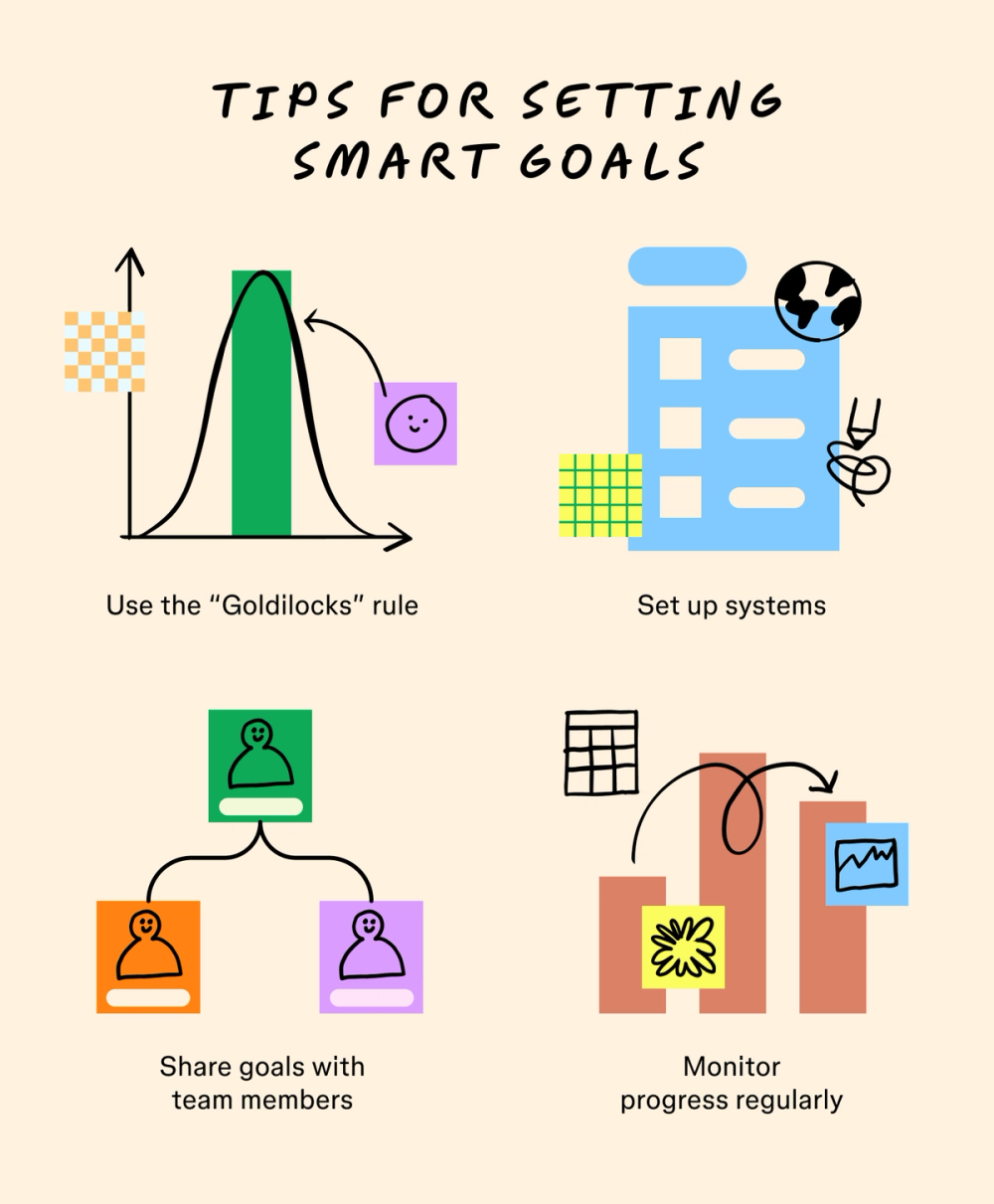
The “Goldilocks Principle” is about finding balance—not too easy, not too hard—but just right. If a goal feels too simple, it’s easy to lose motivation. If it’s too challenging, you may give up. Aim for goals that stretch you but still feel achievable.
Set up accountability systems
Goals need systems to support them. Whether your SMART goal is a solo passion project or a large team effort, track your progress along the way. Logging small wins builds momentum and eventually reveals patterns you can automate or optimize.
Bottom line: The right systems make the process smoother and more satisfying.
Share goals with team members
For team or work goals, make sure everyone is aligned with your project and strategic objectives. Sharing your SMART goals holds everyone accountable for their milestones and deadlines. Plus, team members can prioritize tasks for others, creating a collaborative goal-setting environment.
Monitor progress regularly
Check in on your progress regularly. Use SMART metrics and timelines to guide reviews, like sprint reviews or team syncs. Don’t be afraid to adjust your timeline or scope if things shift.
Be honest about your progress by asking yourself:
- Is my timing realistic?
- Which methods were helpful?
- Which deliverables were out of my control?
- What can I adjust?
Set smarter goals with FigJam
Now that you know how to write SMART goals, it’s time to turn that “goal” into a “go” With FigJam, you can map out your SMART goals and collaborate with others asynchronously on shared goals. Here are a few ways to get started:
- Use the FigJam goal-tracking template to track your goal progress and make adjustments as needed.
- Working on a complex project? Try a strategic planning tool to break it down into digestible pathways.
- Keep the team motivated and inspired to stay on top of their SMART goals with engaging meetings.
Ready to write your own SMART goals?
Get started with templates and tools in FigJam to plan with clarity.
Keep reading


Strategic planning process in 6 steps
Every business needs a great strategic plan to achieve their long term goals.


What is the Eisenhower matrix
Learn how to use an Eisenhower matrix to help prioritize tasks based on importance and urgency.


What is a SWOT analysis
Learn how you can use a SWOT analysis to uncover market forces that could work for or against your big idea.