What is brainstorming? Tips, methods, and templates


Share What is brainstorming? Tips, methods, and templates
Explore more from
Team productivity


Brainstorming is more than just tossing ideas around. It’s a way for teams to unlock fresh thinking, tackle problems, and help teams approach challenges from different angles. It's not about getting everything right on the first try. Rather, it's about surfacing ideas, testing possibilities, and learning from what sticks—and what doesn't.
Even the ideas that don’t go anywhere can move the team forward. Sometimes, all it takes is one comment to shift the conversation and lead to something bigger and better.
With the right tools, a few tried-and-true techniques, and some smart facilitation, your next brainstorming session can become the launchpad that keeps the creative thinking flowing.
Read on to learn:
- The purpose and benefits of brainstorming
- Different brainstorming methods
- How to conduct brainstorming sessions
- Brainstorming best practices
What is the purpose of brainstorming?
Brainstorming helps teams think creatively to solve problems or explore ideas. It encourages individuals and groups to think outside the box.
It's not about rushing to find the "right" answer. It's more about opening up space for different viewpoints and letting concepts bounce off each other, sparking new and unexpected ideas.
Four benefits of brainstorming sessions
Brainstorming is about what happens when people think together. There are a couple of benefits that keep teams coming back to brainstorming.

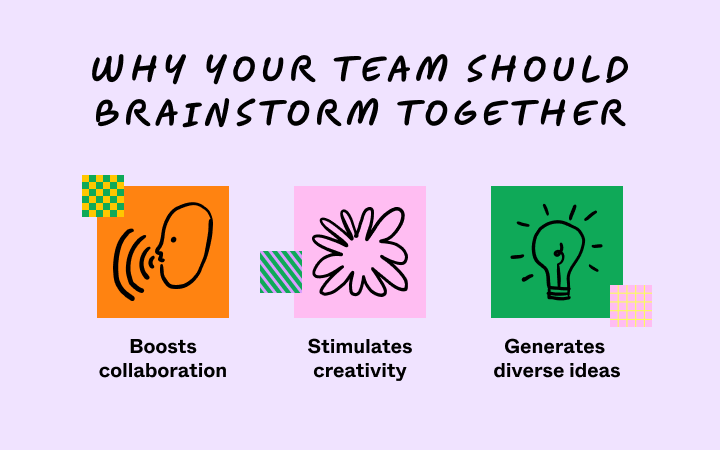
Benefit 1: Boosts collaboration and teamwork
Brainstorming turns individual thinking into a collective effort, boosting collaboration within your group. By creating an inclusive environment, brainstorming allows everyone to contribute, even those who may be less vocal. This approach ensures that diverse perspectives are heard and valued.
Benefit 2: Stimulates creative thinking
The best idea is rarely anyone’s first idea. More often, great ideas emerge when people bounce ideas off each other. Brainstorming encourages participants to explore different directions and discover unique solutions that may not have been obvious initially.
Create an open, nonjudgmental space to give your team the freedom to delve into some unconventional ideas.
Benefit 3: Generates creative ideas
When people with diverse experiences and backgrounds come together, they bring fresh perspectives to the table. By sharing and discussing these ideas, teams can develop creative solutions that cater to a broader range of needs and concerns.
Benefit 4: Encourages shared perspectives
Brainstorming is a opportunity for everyone to share their viewpoints. Faciliating a safe and inclusive space allows participants to unlock new ways of thinking by bringing their individual experiences to the conversation. When leaders foster open communication, the team’s diverse perspectives can spark fresh and innovative ideas.
Types of brainstorming techniques
Different brainstorming methods offer unique tricks for getting ideas flowing and figuring out problems. The type of brainstorming you should use depends on how your team works together, the specific problem, and your desired results.
Check out these 11 FigJam templates that can power up your team brainstorm.
Brainwriting

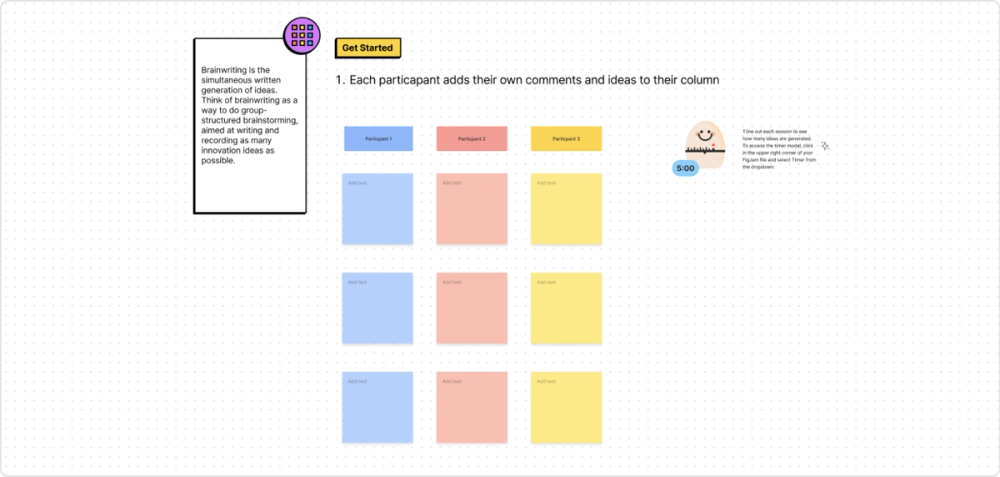
Brainwriting prompts you to write and record as many ideas as possible. Ask a teammate to add their two cents to your idea, and then keep going until everyone's put something in on each idea. Then, pick someone to round up all the written ideas and briefly explain the session
Best for: Making sure everyone gets a chance to share ideas
Reverse brainstorming

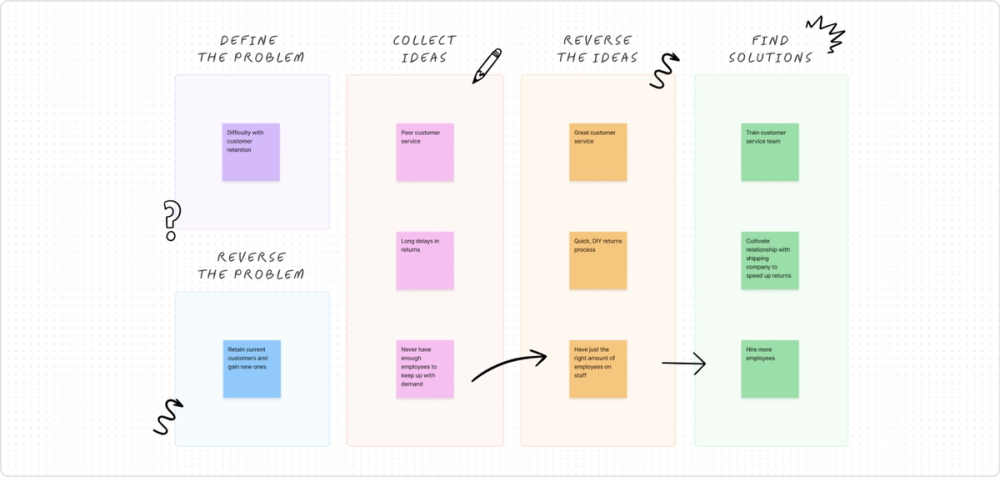
Instead of coming up with solutions, reverse brainstorming is all about thinking of as many reasons or things that could be causing the problem. For example, imagine your product struggles with customer retention. You’ll want to:
- Define the problem you are trying to solve.
- Identify an issue in your system, like poor customer service.
- Reverse the idea by turning negatives into positives—for example, great customer service.
- Talk about ways to achieve the desired positive, like training for your customer service team.
This method can help you spot problems you might not see right away.
Best for: Spotting potential problems and assessing risks
5 whys brainstorming

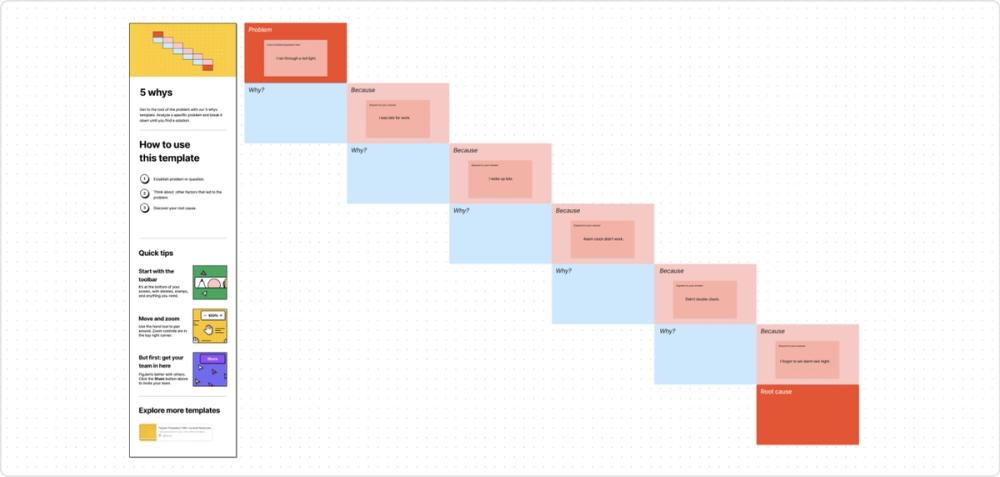
With the 5 whys method, you keep asking “why” until you get to the bottom of a problem. Instead of just taking the first answer, you dig deeper and find the real problems hiding underneath. Once you’ve exposed the problem, you can capture it in a problem statement.
For more information on this brainstorming technique, check out this article on the 5 whys.
Best for: Getting to the root of your problem
Crazy 8

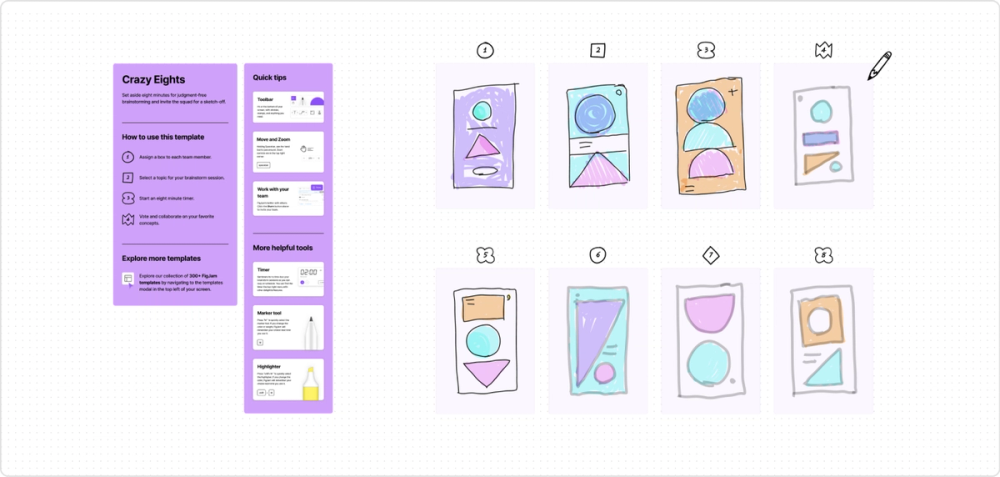
The Crazy 8 exercise is a team drawing challenge in which everyone helps sketch eight new ideas. There is no need for perfection or logic—your only goal is to be creative. Sometimes, the wildest inspiration hits when you least expect it.
Best for: Quick design ideas and visual concepts
Mind mapping

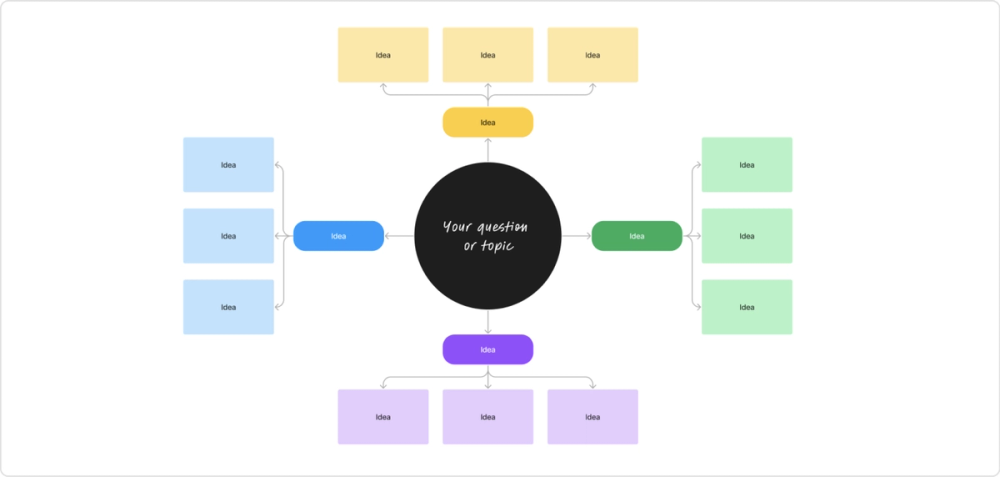
Mind mapping begins with a central idea at the center, with branches connecting related ideas. Once you get your thoughts in order, it's simpler to understand complicated ideas.
For more information on this type of brainstorming, check out this article on how to mind map.
Best for: Organizing complex information and ideas
Starbursting

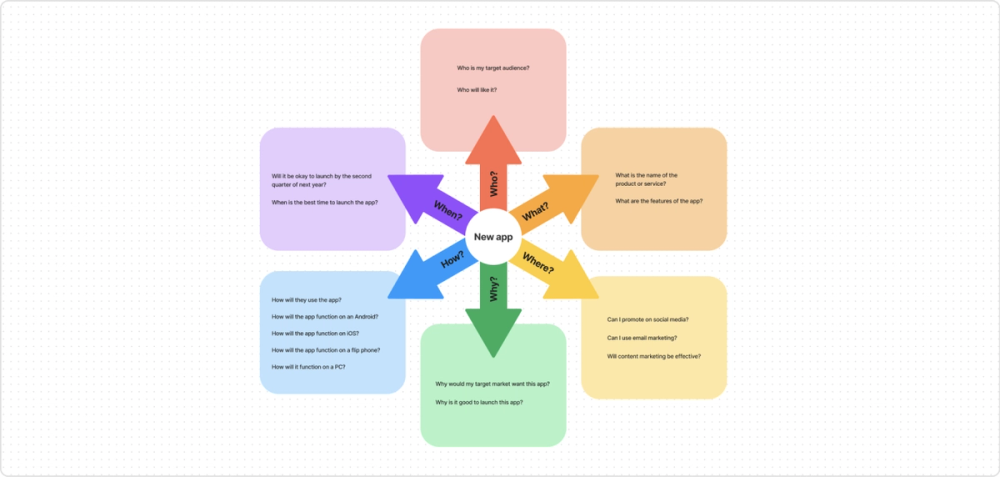
Starbursting is a fun way to brainstorm; it involves asking questions to spark new ideas about fixing a problem or talking about something. If you’re brainstorming a product, each point on the star might represent a key product question; you might ask:
- Who is my target audience?
- What are the features of the product?
- Where is this product being used?
- Why would my target audience want this product?
- When is the best time to launch this product?
Discuss these five questions, then create new questions based on your previous answers.
Best for: Discovering fresh angles
Production vision board

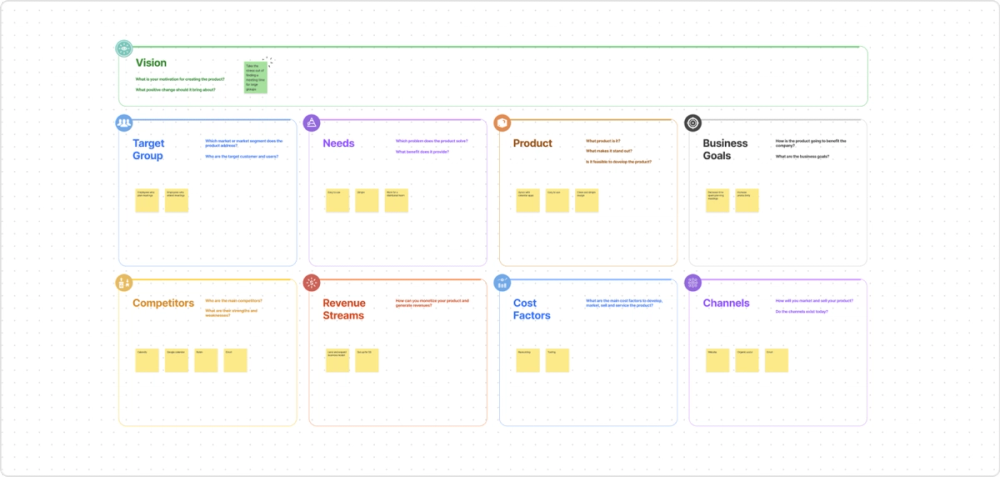
A production vision board helps you visualize your strategy, outline goals, and quickly map out product features and user needs. This keeps the energy up in your brainstorming and stops you from getting caught up in the nitty-gritty.
Best for: Aligning your team on a shared goal or idea
Alt: “Brainstorming: Production vision board”
Rapid ideation
With rapid ideation, the point is to get a whole bunch of ideas down quickly. It's all about getting as many ideas down as possible, even the wild ones. Set a time limit (5–15 minutes) and express as many ideas as possible. Then review with your team and further develop realistic ideas.
Best for: Unblocking your creativity and finding new ideas
The SCAMPER model
The SCAMPER brainstorming model uses an acronym to help guide your team through a brainstorming session. Each letter represents an approach to generating and revising ideas.
- Substitute: What can you replace?
- Combine: What can you merge or blend?
- Adapt: What can you change or adjust?
- Modify: What can you alter or amplify?
- Put to use: How can you use it differently?
- Eliminate: What can you remove or reduce?
- Reverse: What can you invert or rearrange?
SCAMPER gives you a simple framework for brainstorming and to help you develop actionable ideas.
Best for: Expanding on existing ideas and processes
Random word brainstorming
This brainstorming idea is all about getting your creative juices flowing and shaking up how you normally think. Random word brainstorming helps break down mental barriers and adds fun to the creative process.
- Create a list of random words using a dictionary or online random word generator.
- Select one or more random words from the list.
- Have your team explain the connection between the words and the problem you’re solving.
Random word brainstorming is a great way of getting your team to make new connections and see problems in a fresh light.
Best for: Sparking unusual and highly creative ideas
Cubing
The cubing brainstorming method asks everyone on the team to look at a problem from six different angles (like the sides of a cube). This method encourages you to see your topic from all sorts of different viewpoints. The six prompts to explore during a cubing brainstorming session include:
- Describe: What does your topic look like?
- Compare: What is your topic similar to and different from?
- Associate: What does your topic make you think of?
- Analyze: What are the elements of your topic?
- Apply: How can your topic be used?
- Argue: What are your topic’s strengths and weaknesses?
The cubing method helps teams really dig into a topic and discover solutions they might've missed.
Best for: Getting a complete understanding of a topic
How to run a brainstorming session in five steps
Ready to run your own brainstorming session? Here’s a simple five-step guide.

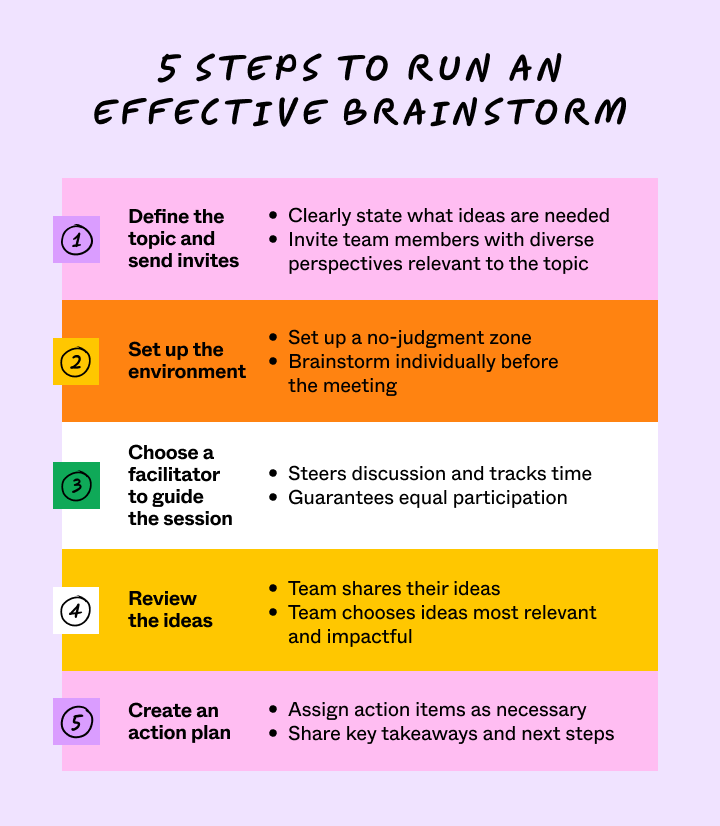
Step 1: Define the topic and send invites
Before you start brainstorming, you need to outline what you’re tackling—the topic or problem. This lets your team know what ideas you're hoping for and why they're part of it.
Ask team members who see things differently and have different ideas about what you're working on. Try to keep the group small enough so everyone can get involved and there's a good back-and-forth of ideas.
Step 2: Set up the environment
Many teams run remote brainstorming sessions, especially since studies of virtual brainstorming show that it can be more effective than in-person brainstorming. For many people, sharing ideas through a screen is easier and more comfortable.
Try giving your team a heads-up task, like having them brainstorm solo before the main session. This gets people thinking over the topic or problem and gives you a head start with ideas. You’re aiming for quantity here, not perfection.
Pro tip: To make sure everyone's on the same page and you don't waste any time, send your team a meeting agenda beforehand.
Step 3: Choose a guide to lead the session
For a productive brainstorming session, having a guide to keep things organized, manage time, and ensure everyone has a chance to contribute is helpful.
Extroverts might dominate the conversation, while introverts may stay quiet. Newbies and junior team members may feel overshadowed by higher-ups. Your guide should have the leadership skills necessary to keep everyone engaged.
Pro tip: Use a Figma timer to help your team stay on track with idea presentations.
Step 4: Review the ideas
Look over the ideas and see which ones are the real standouts. Which ideas are the most relevant, possible, and have the largest potential impact?
To help everyone feel comfortable sharing, consider offering a prize to encourage brainstorming participation. Figma’s Andrea Helmbolt recommends gift cards to a coffee shop, stickers, or selfie sticks to reward those tossing out ideas.
Pro tip: Encourage participation and minimize worry with voting widgets that let members share their thoughts anonymously.
Step 5: Create an action plan
After selecting your best ideas, create an action plan. Get going by assigning tasks and setting due dates so everyone knows what they need to do and when they should do it.
After the meeting, share a brief recap focusing on key ideas and discoveries. Create energy by pointing out any wins and the interesting possibilities you found when brainstorming.
Pro tip: Create a poll to gather feedback about the brainstorming session so you can make the next round even better.
Seven best practices for brainstorming sessions
Before diving into your next brainstorming session, think about these tips to help improve it and keep everyone focused and working together.
- Record all ideas. During your brainstorming session, write down all ideas so nothing is lost. Even small ideas may spark creativity later.
- Make sure everyone is heard. Take turns sharing ideas and encouraging active listening to get a range of perspectives.
- Focus on quantity. Encourage everyone to just say whatever they're thinking, so the ideas can pour out.
- Keep it flexible. Brainstorming is about flexibility and new possibilities. Don’t make sessions too structured.
- Avoid criticism. Keep things positive and don't let anyone say anything negative, so people feel okay with taking chances.
- Set a time limit. To prevent your session from lasting too long, set a time limit of 15, 30, or 45 minutes and stick to it.
- Build on ideas. Explore possibilities by building on existing ideas; this also helps encourage collaboration and teamwork.
Enhance collaboration and boost creativity with FigJam
Kick-off brainstorming by creating a FigJam shared online whiteboard that everyone can come up with and deliver awesome ideas. Try these Figma tips and tricks to keep brainstorming sessions exciting and effective:
- Use a brainstorming template from the Figma Community to help lead a creative, collaborative session.
- Take advantage of Lotus diagram templates to help organize your ideas into a more manageable format.
- See how you can use the FigJam app on iPad to sketch out ideas and jot down notes.
Ready to organize an inspiring brainstorming session? Start brainstorming with FigJam.
Ready to organize an inspiring brainstorming session?
Keep reading


What is a lotus diagram?
Brainstorming sessions feeling scattered? Find clarity within the chaos with a lotus diagram.


How to make a concept map
Learn how to organize and connect a set of related concepts in a simple visual diagram.


How to mind map
Learn what it is, why you use it, and the steps to create a mind map.