What is a SWOT analysis? + How to perform one


Share What is a SWOT analysis? + How to perform one
Explore more from
Strategic planning

Your next big idea—an AI-based self-help tool—could be the next business breakthrough. But with technology changing every day, you need to know where you stand and how to position yourself for success.
A SWOT analysis provides a clear, structured way to uncover internal factors (like a team of AI and mental health experts) and external market forces (like fierce competition in all things AI) that could work for or against your big idea before you make your pitch for funding and resources.
Read on to learn:
- What a SWOT analysis is
- What a SWOT analysis can do for you
- How to create a SWOT analysis in five steps
Start your SWOT Analysis with FigJam
Build, design and share your SWOT analysis all in one file
What does SWOT stand for?
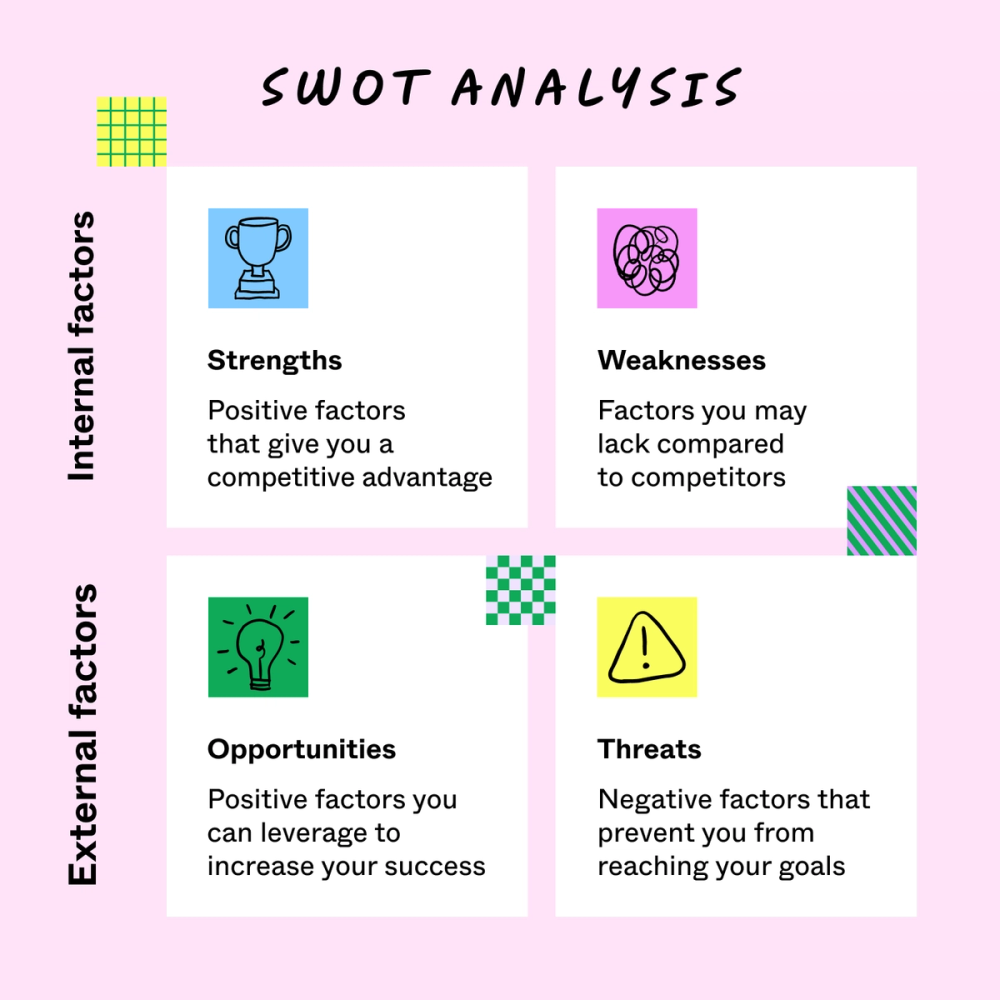
SWOT stands for strengths, weaknesses, opportunities, and threats. As one of the most widely used strategic planning tools, a SWOT analysis helps you look up from daily tasks and consider the bigger picture for your project, product, or organization.
With FigJam’s SWOT analysis template, you can collect internal input and external market insights, allowing you to see what’s working, where you can improve, and where market gaps present opportunities.
Here’s a more detailed SWOT analysis definition.

Strengths
The “S” in SWOT refers to “strengths”—these attributes that give your idea, product, or company its competitive edge. Strengths might include innovative technology, user-centric designs, or even a highly engaged audience.
To uncover your strengths, ask questions like:
- What is your competitive advantage?
- What sets you apart from similar companies?
- What positive customer feedback do you frequently receive?
Weaknesses
The “W” stands for “weaknesses,” which are internal factors that may hold back your project. For instance, your company may struggle with scalability, limited resources, or insufficient insight into user needs. Gaining clarity into these areas of weakness helps you take necessary steps to address them before they become a major bottleneck.
To reveal potential weaknesses, ask:
- What do your competitors do better?
- What constructive feedback do you receive from customers?
- What do you feel isn’t working as well as it could?
Opportunities
“O” stands for “opportunities.” This refers to external factors you can leverage to increase your success. Examples include market trends, technological advancements (such as AI), or changes in consumer behavior. Your goal is to understand what’s happening outside your business and how you can leverage it.
To dig into your opportunities, think about:
- What industry trends could you leverage?
- Are there opportunities to expand into new markets?
- Do any partnership opportunities exist?
Threats
Finally, the “T” in SWOT refers to “threats.” While you may benefit from opportunities, threats are external forces that could get in the way of success. Examples include rapidly rising competitors, major technological changes, or security risks. If you identify these threats early, you can determine strategies to lower risks and increase success.
To help pinpoint possible threats, ask:
- Who are your major competitors?
- What industry trends may cause challenges for your company?
- Are there areas where your security could be tighter?
How to do a SWOT analysis in five steps
A SWOT analysis helps you make more informed decisions, spearhead innovative ideas, and avoid possible pitfalls. Here’s how to make one in a few simple steps.
Step 1: Gather your team
Invite colleagues from cross-functional departments to ensure a well-rounded analysis. A diverse, cross-functional team with varied perspectives provides a more complete view of your project. Of course, make sure to include key stakeholders as well.
At your team kickoff, share the purpose of your SWOT analysis. Are you focusing on a specific project, product, or business initiative? Rally your team around that shared goal. For the best results, focus on SMART goals) so everyone feels invested in the outcome.
Step 2: Brainstorm ideas
Once you’ve defined your objectives, start brainstorming. Be sure to foster open, focused discussion as you guide your team through each SWOT component. Use focused discussion prompts to facilitate the conversation, like:
- Strengths. What does your company or product do well? What sets it apart from competitors?
- Weaknesses. Where is there room for improvement—technology, funding, staffing gaps?
- Opportunities. What external factors can you leverage for success? Think about untapped markets, consumer trends, or technologies.
- Threats. What could negatively impact your project or product? Consider news about competitors, changing market conditions, or emerging regulations.
Remind the team that all ideas are worth sharing. The more ideas they throw out, the likelier you’ll uncover a great one.
Here are a few ideas to get the most out of your work together:
- Create time boxed sessions for each SWOT quadrant to keep things moving.
- Try frameworks like the SCAMPER method or concept mapping to generate fresh perspectives.
- Use FigJam’s interactive features to keep sessions engaging.
Pro tip: Check out FigJam's brainstorming best practices to uncover collaboration strategies and facilitate better sessions.
Step 3: Analyze the results
Once you’ve collected insights about internal and external forces, look for connections between your SWOT components to identify strategic opportunities. Your analysis may reveal areas for growth that you might not have considered yet, helping you stay ahead of the game. As an example, try to match strengths with opportunities to create competitive advantages or identify what might be quick wins over long-term initiatives.
Step 4: Develop an action plan
When you have a clear picture of your SWOT components, create an action plan and:
- Set clear goals tied to your strongest opportunities
- Create specific tasks
- Assign owners, delegate work, and set timelines with realistic deadlines
- Establish success metrics
- Schedule regular progress reviews
Step 5: Review, revise, repeat
With your action plan in place, continue monitoring progress and adjust your strategies accordingly. Treat your SWOT analysis as a living document. Schedule regular check-ins and reviews to:
- Track progress on action items
- Update your SWOT analysis based on market changes
- Identify emerging opportunities or threats
- Adjust priorities based on new insights
SWOT analysis example

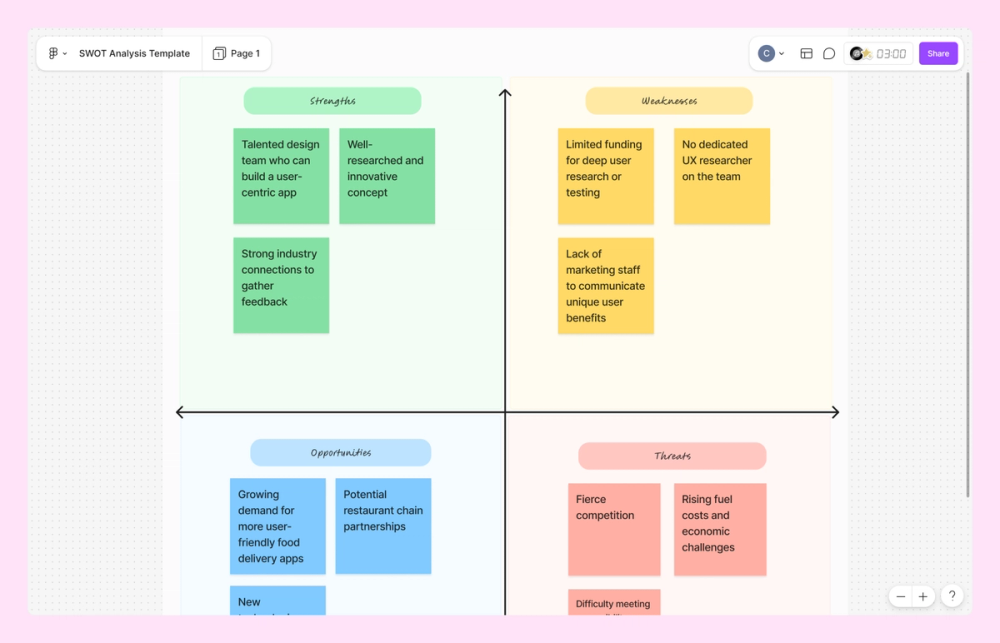
Here’s how a SWOT analysis shapes strategy for a new food delivery app focused on user experience:
Strengths
- Talented design team who can build a user-centric app
- A well-researched and innovative concept
- Strong industry connections to gather feedback
Weaknesses
- Limited funding for deep user research or testing
- No dedicated UX researcher on the team
- Lack of marketing staff to communicate unique user benefits
Opportunities
- Growing demand for more user-friendly food delivery apps
- Potential restaurant chain partnerships
- New technologies like AI to improve personalization
Threats
- Fierce competition
- Rising fuel costs and economic challenges
- Difficulty meeting accessibility requirements across various devices
Given this analysis, what do you notice? It’s clear you’ve got a talented team capable of creating an app that delights users and provides an excellent experience. However, broader economic concerns, high competition, and limited resources may get in the way of your success. Consider how to connect these points with an action plan.
For instance, you might explore conducting lean user research, prioritizing personalization and accessibility to differentiate your app among users, and building partnerships with restaurant chains.
Benefits of a SWOT analysis
A SWOT analysis helps teams get the lay of the land and make strategic decisions with confidence. That’s because a SWOT analysis:
- Improves strategic planning. You can’t effectively build a strategy without knowing the relevant factors that could impact it. A SWOT analysis provides a helpful framework to assess the current state and determine a plan for the future.
- Informs decisions. A SWOT analysis gives you a full view of your environment, making it easier to weigh your options, prioritize your strategies, and make more informed, data-driven decisions.
- Enhances adaptability. A SWOT framework helps you proactively stay on top of market trends, shifts in customer behavior, and evolving economic conditions.
- Offers a competitive advantage. A SWOT analysis helps you identify and leverage your unique strengths to differentiate your product in the market.
Create your SWOT analysis with FigJam
A SWOT analysis can be a simple and powerful tool to power your team’s success when strategic planning. FigJam’s tools and templates can help you gain clarity on where you’re succeeding, where you can improve, and how to work with external factors to increase your success. Here’s how:
- Brainstorm insights, make a plan, and self-reflect with FigJam’s collaborative online whiteboard.
- Jump right in with a pre-made SWOT analysis template.
- Make everyone’s voice heard during team meetings by utilizing features like audio, stamps, and timers.
Ready to design your SWOT analysis?
Try designing and collaborating in FigJam today for free