How to use the 5 whys: Root cause analysis explained


Share How to use the 5 whys: Root cause analysis explained
Explore more from
Team productivity


Imagine you’re designing a new e-commerce website. Everything’s going well until QA, when you discover bugs in the checkout process. Are they unrelated issues or symptoms of an even bigger underlying problem? You need to find the root cause of the problem—and the five whys can help.
To tackle a tricky problem, break it down with the five whys root cause analysis.
This article covers this key problem-solving technique, including:
- Explaining the five whys method
- How to simplify the five whys technique
- A step-by-step guide on how to use it with your team
- Examples of how it works, plus troubleshooting tips
What is the 5 whys technique?
Ever notice that kids keep asking why, even after you give them an answer? That's exactly what the five whys technique does. As it turns out, you can learn a lot from a child’s stubborn curiosity. Through iterative questioning, you can dig into a specific problem and sort through cause-and-effect factors.
To reach the root cause of a problem, just ask “why?” five times—hence the name. It’s a simple, effective tool for root cause analysis.
A brief history of the 5 whys analysis
In a root cause analysis, 5 whys aim to reveal a certain problem or issue. Each repetition of the question reveals a deeper layer.
You can trace the five whys technique back to Sakichi Toyoda, a Japanese inventor who introduced it to the Toyota Production System as a rigorous approach to problem-solving for lean manufacturing. He found that by persistently asking why, you can uncover the underlying causes of the problem and find effective countermeasures.
As Toyota’s Taiichi Ohno explained, with the five whys, “the nature of the problem as well as its solution becomes clear.” This culture of healthy curiosity is also reflected in Toyota’s key principle of “go and see,” encouraging workers to observe on-site issues and workflows in person.
Today, as a valuable starting point for problem-solving, the five whys method plays a key role in lean management methodology and DMAIC Six Sigma continuous improvement. Whether you’re a project manager, product designer, or startup founder, the five whys technique can help you tackle problems and drive continuous improvement.
Benefits of the 5 whys process
The 5 whys technique helps you look past easy answers and temporary quick fixes so you can get to the root cause of the problem. The 5 whys method trains you to:
- Dig deeper. Look beyond the initial problem and superficial symptoms for a deeper cause-and-effect analysis.
- Think logically. Start with common sense before investing in time-consuming metrics analysis.
- Make informed choices. Become a decision-making facilitator, providing a holistic understanding of the project.
- Identify pain points. Fix reoccurring problems and mistaken conclusions with swift, corrective actions.

How to use the 5 whys method
A systematic approach helps make the five whys one of your most valuable analysis tools for problem-solving, decision-making, and continuous improvement. The keys to successful implementation are clear problem statements, a diversified team, lively brainstorming sessions, smart corrective actions, and close monitoring.
So, what are the 5 whys of root cause analysis? Here's a step-by-step guide to help you and your team members apply this methodology.
Step 1: Craft your problem statement
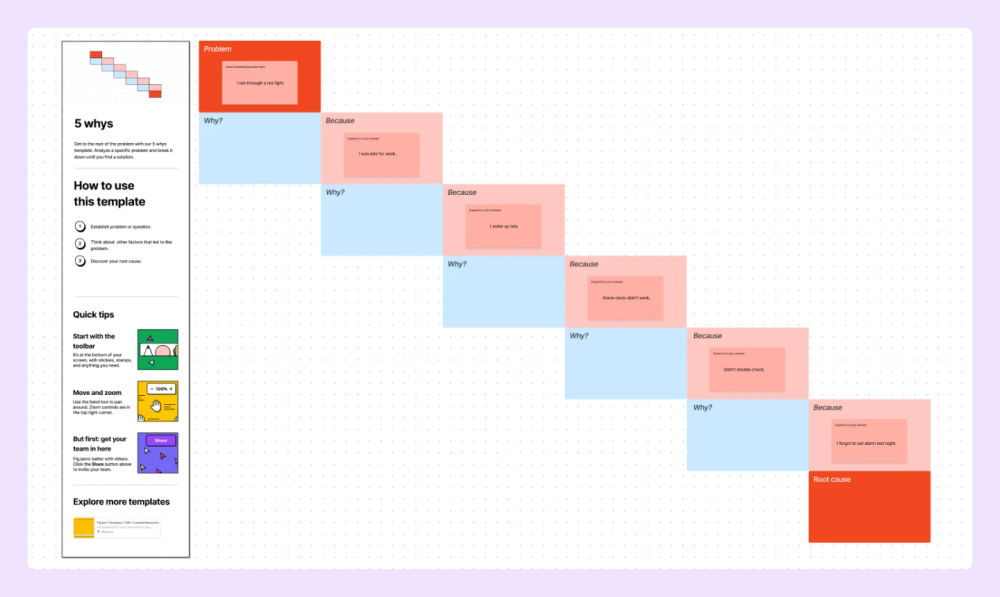
Start by summarizing the issue you're addressing with a well-crafted problem statement. Use Figma’s 5 whys template to create a concise, visually engaging problem statement. What challenge are you facing? Who does it impact? Why is it important to fix? Consider these initial questions as you write a problem statement and begin working toward a solution with the 5 whys.
Step 2: Gather cross-functional team members
To gain different perspectives, assemble cross-functional team members from various disciplines who are knowledgeable about the problem. Designers, engineers, and researchers bring complementary insights to problem-solving—and when team members agree on the root cause of a problem, changes are much easier to implement.
Step 3: Brainstorm with the 5 whys method
Assemble team members for a brainstorming session to uncover ideas that may not have occurred to you individually. Facilitators should encourage open, honest conversation. No idea is a bad idea at this stage. Keep asking “why?” to dig deep into the problem and uncover underlying causes.
- How do you know when to stop? Stop when asking “why?” no longer produces useful responses and a solution has presented itself.
- What if you uncover more than one problem? Split your diagram into multiple lanes. Continue asking “why?” for each problem until you find its root cause.
FigJam makes it easy for diverse teams to collaborate in this process in real time with its shared online whiteboard. A visual interactive approach keeps the process engaging and captures every insight. Combined with Figma’s design capabilities, teams can translate their findings into prototypes or actionable improvements.
Step 4: Identify countermeasures
Once you have a better idea of the real cause of the problem using the 5 whys, explore corrective actions. Instead of treating the symptoms, how can you address the underlying causes? Assess each countermeasure for feasibility, impact, and alignment with your goals. Troubleshooting might not require elaborate re-engineering—according to Airbnb co-founder Joe Gebbia, low-tech creative problem-solving transformed Airbnb’s business.
Step 5: Take corrective actions
Assign responsibilities and establish clear timelines for each corrective action. Then monitor progress closely, incorporating findings and feedback for continuous improvement. The insights you gain will help inform decision-making on future projects and help your team with problem-solving and ongoing quality improvements. Create an action plan to hold everyone accountable.
Revisit the issue after a set time. Did your changes and ideas have a positive impact? If not, repeat the 5 whys and implement new solutions. Take care to document the entire process.
Problem-solving with 5 whys examples
To bring the power of the 5 whys technique to life, consider these real-world examples.
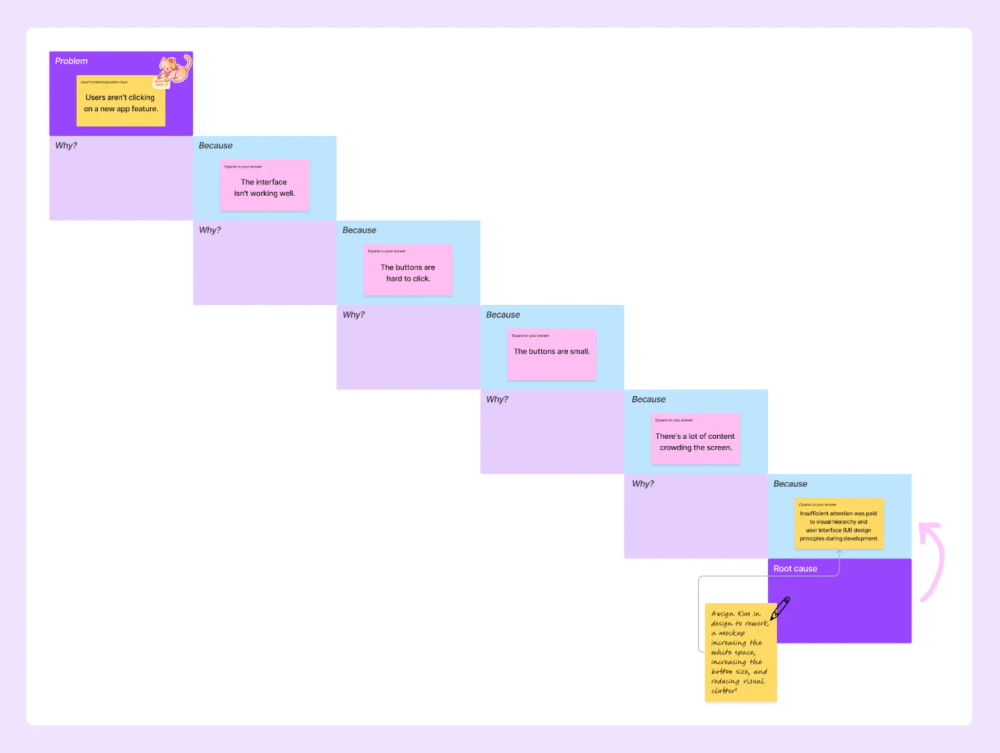
Example 1: Users aren’t clicking on a new app feature

Get this 5 whys root cause analysis template
You’ve designed a new app feature, but users aren’t clicking on it. By asking the right questions, the 5 whys method helps you understand what’s going on.
- Why aren’t users clicking on the feature? The interface isn’t working well.
- Why isn’t the interface working well? The buttons are hard to click.
- Why are the buttons hard to click? The buttons are small.
- Why are the buttons small? There’s a lot of content crowding the screen.
- Why is content crowding the screen? Not enough attention was paid to visual hierarchy and user interface (UI) design principles during development.
In this example, the 5 whys analysis reveals that the root cause of the problem is the flow, not a technical glitch. With the five whys, the team can take corrective action to improve the user experience. Some possible solutions include increasing the size of the CTA button, simplifying the layout, and improving the overall visual hierarchy by using more contrast, white space, and visual cues to guide users.
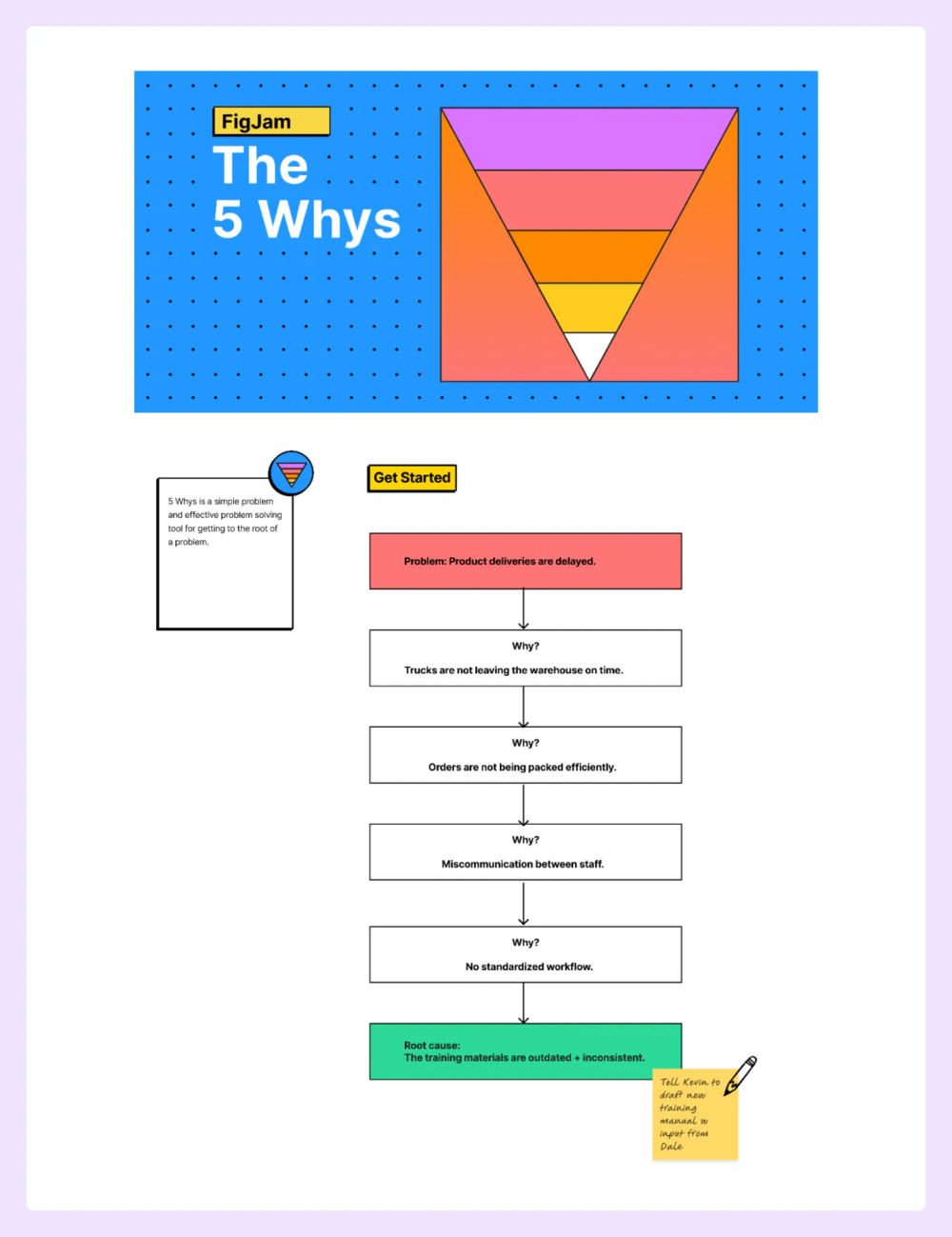
Example 2: Deliveries aren’t arriving on time

Get this 5 whys root cause analysis template
For another way to visualize the line of questioning, let’s look at a logistics team coping with frequent delays in product deliveries:
- Why are deliveries delayed? Trucks aren’t leaving the warehouse on time.
- Why are trucks not leaving on time? Orders are not being packed efficiently.
- Why are orders not being packed efficiently? There’s miscommunication between staff.
- Why is there a miscommunication? There are frequent miscommunications because there’s no standardized workflow.
- Why is there no standardized workflow? The training materials are outdated and inconsistent.
With the answers to these five questions, you might determine that updating training materials and implementing a clear workflow could resolve the delays.
When to use the 5 whys methodology
Whether you’re brainstorming or troubleshooting, the 5 whys method gets creative teams asking the right questions to find solutions and make meaningful quality improvements.
Its simplicity and focus on iterative questioning make it a valuable tool for tackling issues in design, marketing, product development, and other collaborative environments. But solving systemic problems (like in healthcare and manufacturing, for example) with complex metrics may require more advanced root cause analysis tools to account for multiple variables and interdependencies.
Consider trying the 5 whys approach when dealing with:
- Straightforward problems. For issues with clear symptoms and relatively simple root causes, the 5 whys provide a quick, efficient way to uncover actionable insights. For example, it can help a design team address why users are abandoning their carts during an e-commerce site’s checkout process.
- Creative ideation. The 5 whys root cause analysis technique encourages out-of-the-box thinking, making it great for generating new ideas or identifying barriers to innovation.
- Team collaboration. Trying to get everyone on the same page? The 5 whys is a structured yet open-ended way to foster collaboration, helping teams align on a problem and its root cause identification. It’s also an excellent way to open up discussions and allow everyone to give their perspective.
When not to use the 5 whys methodology
The 5 whys methodology is a powerful tool for identifying root causes, but it’s not a one-size-fits-all solution. To avoid incomplete or misleading analyses, consider these limitations:
- Oversimplification of complex problems. In situations where multiple root causes are interconnected, the linear approach of the 5 whys may create too narrow a focus and miss the bigger picture.
- Inherent bias. The success of the 5 whys method depends on the facilitator’s ability to ask the right questions and get honest answers. Personal biases or inadequate knowledge about the issue at hand can lead to inaccurate conclusions.
- Focusing on symptoms instead of root causes. Teams may end up identifying symptoms instead of true root causes. For example, if a team concludes that a deadline was missed because “someone forgot,” they may fail to explore deeper issues such as inadequate training, poor communication, or unrealistic workloads. To avoid this, keep asking “why?” until the answers point to systemic or process-level issues rather than individual failures.
- Lack of quantifiable evidence. The 5 whys methodology often relies on qualitative insights, which can be subjective and difficult to validate. This can be a major drawback in industries where data plays a crucial role. Teams might identify a plausible root cause but lack the evidence to confirm it. In these cases, pairing the 5 whys with more data-driven tools like process mapping can provide more reliable results.
Alternatives to the 5 whys method
Root cause analysis works best for critical thinkers tackling problems caused by one core issue. But when you’re up against more complex problems, it might help to take a different approach. In these cases, try:
- A flow chart for following each step of a journey and pinpointing where issues arise
- A fishbone diagram for mapping out multiple cause-and-effect relationships
- A failure mode and effects analysis (FMEA) to uncover opportunities for improvement and prepare for mishaps before they happen
A 5 whys root cause analysis helps you dig deep—but you’re digging straight down. An alternative or supplementary visual aid (like a fishbone diagram or flow chart) lets you branch out, exploring different possibilities and errors you may encounter at various points in your process.
Jumpstart your 5 whys analysis with FigJam
Ready to start problem-solving with the 5 whys root cause analysis? FigJam’s drag-and-drop design tools make it simple to customize diagrams and add brand flair. Here’s how:
- Make problem-solving easier for your team with FigJam’s 5 whys template.
- Want more ideas? Find inspiration from FigJam's design community.
- Boost team troubleshooting with an Ishikawa or fishbone diagram.
Start brainstorming and diagramming with FigJam.
Keep reading


How to write a problem statement: A step-by-step guide
Learn how to get organized and create a game plan to solve your problem.


What is a fishbone diagram—and what can it do for you?
Use a fishbone diagram to help you solve problems by understanding what’s causing them.


How to create a flow chart
Having a flow chart can help visually represent actions or people in a complex situation.