What is a service blueprint?


Share What is a service blueprint?
Explore more from
Team productivity

When customer satisfaction slumps, service blueprints come in handy. These roadmaps detail every step in your service delivery process, so that you can find and fix pain points—and optimize the user experience.
Read on to find out:
- How service blueprints can improve customer experience across key touchpoints
- How teams tweak service design to curb inefficiencies – including a best-practice service blueprint example made with FigJam's service blueprint template
- 5 key elements of a service blueprint
- How to make your own service blueprint in 5 steps
Service blueprints in practice
The service blueprint isn’t an abstract artifact, but a touchstone of real-time service management. Since G. Lynn Shostack introduced the concept in her 1984 Harvard Business Review article, service blueprints have been used across industries, from restaurants to delivery apps. The key to any successful service blueprint remains the same: capturing customer interactions from the customer's perspective.
Benefits of service blueprinting
Teams working on the service design process need a big-picture overview to see past work silos, and spot areas for improvement. Where could you streamline service, and where might you need to upgrade to high-touch service? You can use service blueprints as a starting point to speed service delivery and brainstorm new services to wow customers. Then track steps you take toward service experience optimization, capturing metrics and milestones your team achieves.
Service blueprint example
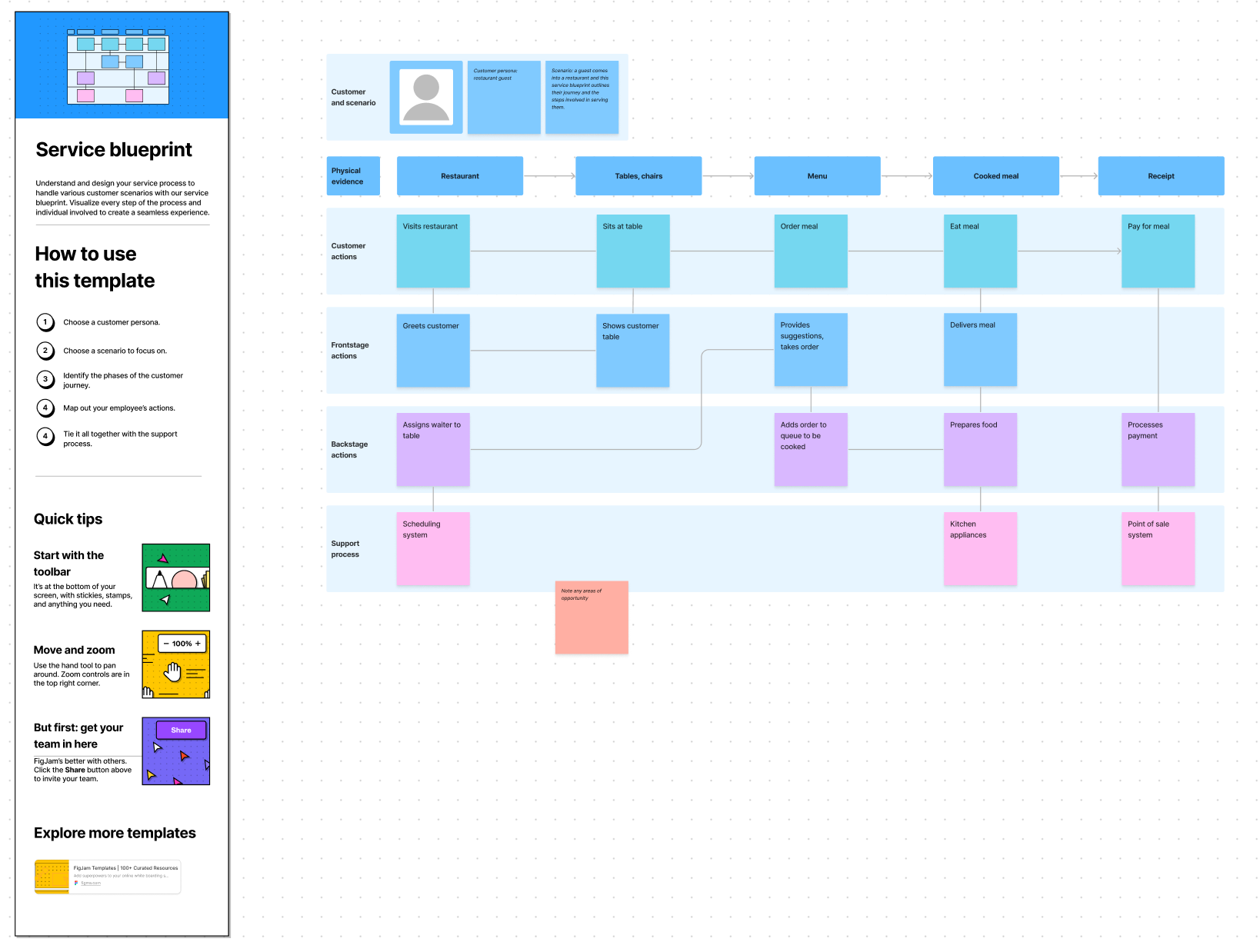
To see how Shostack's theory works in practice today, check out this service blueprint example made with FigJam's service blueprint template:

How to read a service blueprint
Like the restaurant example above, your service blueprint tracks your customer journey map alongside your service delivery process. You'll notice team member actions that customers see (frontstage actions) as well as actions they don't see (backstage actions). A line of visibility separates these two types of employee actions, with support processes and lines of internal interaction running in the background.
5 key elements of a service blueprint
An effective service blueprint has five key features:
- Physical evidence. Identify anything you use to communicate with customers that they can see, feel, hear, touch, or smell. In the restaurant example above, tangible inputs include menus, advertising, and retail locations.
- Customer actions. List customer activities, choices, and direct interactions with staff to reach a goal. Gather this data through research or a customer journey map.
- Frontstage actions. Name human-to-human or human-to-computer actions that your customer can see. Include different departments and platforms, from hospitality staff to ordering interfaces.
- Backstage actions. Cover systems and staff that support customer service delivery. In a restaurant, this ranges from ordering databases to kitchen staff and delivery drivers.
- Support processes. List all the steps support employees take to serve customers. Cover simple and complex processes, including payroll, HR, and supply chain management.
How to make a service blueprint in 5 steps
A service blueprint can be a game-changer for your service design. Use this step-by-step guide to create your own.
Step 1: Sketch out customer actions across your service process.
Trace customers’ steps through your service delivery process. Consider the restaurant example above: The customer goes to the restaurant, sits at a table, orders, eats, then pays for the meal. Tell the story from the customer's point of view, and capture every interaction customers have with your service.
Step 2: Note physical evidence of service design.
For each step in your service process, list tangible elements that could influence customer perceptions. The door, tables, chairs, menu, meal, and receipt are all key physical aspects of restaurant service design.
Step 3: Capture frontstage and backstage actions.
Define employee responsibilities within the blueprint clearly, including frontstage and backstage actions. Frontstage actions are those that happen in the direct view of the customer, while backstage actions are hidden from the customer's view.
In the Figma example above, hosting and waiting represent frontstage actions. Table assignment, order management, food preparation, and payment processing are backstage actions.
Step 4: Highlight support processes.
Consider systems and staff that are essential for service delivery and overall employee experience, but only serve the customer indirectly. For example, cleaning, staff scheduling, and inventory systems are common restaurant support processes.
Step 5: Pinpoint service dependencies and improvements.
Review your service blueprint. Notice areas where your service process could improve, from staff onboarding and scheduling to physical products and digital assets. Then flag opportunities for service innovation, like customer reactions, time estimates for internal processes, duration of customer actions, potential bottlenecks, and fail points.
Draw lines of interaction to show how stakeholders can work together at pivotal moments. Your finished map should show team members exactly when and where to step in, for smoother workflows and efficient service delivery.
Jumpstart your service blueprint with FigJam
Use FigJam's service blueprint template to drag and drop shapes onto your blueprint, where they automatically snap to the grid. Built-in tools help you customize your blueprint with your company's brand color scheme, typeface, and logo.
Then invite your team to comment and collaborate in real time with FigJam's online collaborative whiteboard. Pro tip: name your service improvement goals at the top of your blueprint, to keep your team focused.
Ready to improve customer service?