
What makes designers and developers happy at work?



According to our recent survey, here are the five key factors impacting the happiness of designers and developers at work—and how to optimize them.
Share What makes designers and developers happy at work?
Illustration by Marco Quadri
Defining happiness at work can feel like a slippery task. Happiness is inherently subjective, which makes it tough to define, measure, and report. But in today’s landscape of evolving tools and technologies—and its attendant anxieties— it’s more important than ever to understand how teams are navigating and experiencing change.
That’s why happiness is one of the major themes we addressed in our State of the Designer 2025 survey, which asked 943 designers and developers about the key forces impacting how teams build products together. In addition to our detailed report on the survey results, we’ve added context and additional insights that design leaders at Spotify and Wise shared in our recent livestream.


of designers and developers say they’re more satisfied at work this year than they were last year
Our data tells us that product builders are mostly happy at work with 41% of designers and developers more satisfied than they were last year. So what impacts their happiness, and how can we drive an upward trend? Here, we dive into five crucial contributors to happiness, along with the role that organizations, managers, and individuals can play in fostering a more positive environment.

For more insights, check out the full report here.
1. Design's place in the organization
When an organization sees design as a strategic partner—rather than a service—it will likely boost the job satisfaction of the creative minds that work there because it “comes with a higher level of customer centricity,” says Marianne Guillen, Senior Director, Editorial & Design Platform at Spotify in our State of the Designer livestream. “That allows designers to make the strategic impact [they’re] looking for.”
Josh Payton, Vice President of Design at Wise, says there are things designers can do to level up how cross-functional partners and leaders think about the design organization, such as knowing when to move from exploration to action. “A lot of times designers will get in trouble for discovery phases that never end,” says Josh. “One of the main design principles we have is ‘now, next, future.’ Spend 70% of your time focusing on what you’re delivering now, 20% on what’s next, and 10% on the future.” By balancing freeform exploration with day-to-day deliverables, designers show that they’re able to elevate craft and act as a strategic partner to product and engineering stakeholders.
2. Company policies on hybrid work


of respondents work remotely at least some of the time, and more than half are fully or mostly remote
Where work happens has become as important as the work itself. An organization’s approach to hybrid or flexible working is a huge contributor to how people feel about their jobs. Ninety-seven percent of respondents told us they work remotely at least some of the time, but a one-size-fits-all policy may not succeed.
Hybrid setups can feel like an awkward middle ground, says Josh, citing a recent conversation: “I have a colleague who said that it’s best to go full remote or full in-house because what you end up with is nobody coming into the office on Mondays and Fridays, and then on Wednesday a million people turn up and there’s nowhere to sit or open conference rooms.” Whichever approach you take, it’s important to have clear policies and expectations for employees.
3. How leaders empower their teams
Leadership and management have a key role to play here. They can see what’s happening on the ground and have the decision-making authority to help their teams do their best work—and ensure it gets rewarded. Good managers are sensitive to what kind of support their team needs. Josh has this simple policy: “I don’t care about the hours, and I don’t care about where you do your work, as long as it’s good.”
4. Effective collaboration and communication
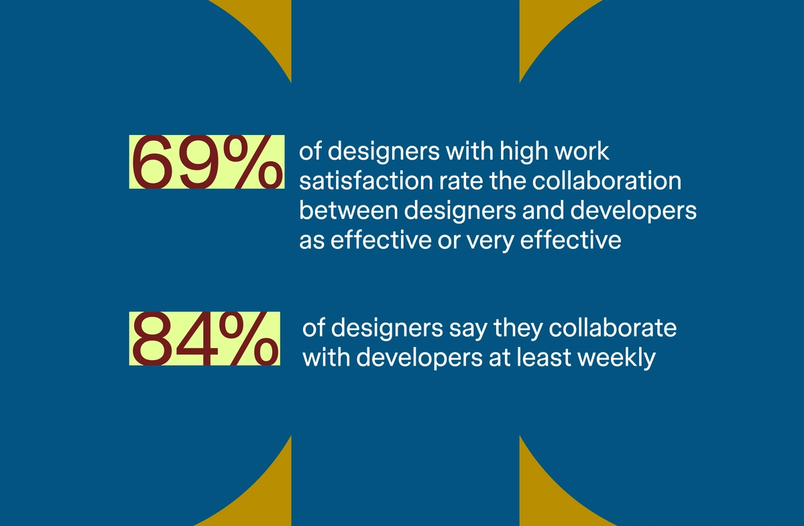
Out of the number of designers reporting high work satisfaction, 69% of them rate their collaboration with developers as effective or very effective. Plus, developers with higher job satisfaction collaborate more frequently with designers. As product development has become iterative and nonlinear, teams are working together more closely than ever; it’s no surprise that collaboration is key to unlocking team and individual satisfaction.
This correlates with an increase in communication. Eighty-four percent of designers say they collaborate with developers at least weekly, and the tools they use to do their jobs are doing some of the heavy lifting. Happy designers and developers are far more likely to use whiteboarding and collaborative design tools—likely because of the way they facilitate multiplayer collaboration.

However, 91% of developers and 92% of designers think there’s room for improvement in the process. And when there is misalignment, 47% of developers say it’s caused by designers’ lack of understanding of the engineering process. “I would encourage designers to explore a little bit, to understand the code better or how modern development works,” says Marianne. “I don’t expect them to become engineers, but to speak a common language.”
5. Tools for self-empowerment
Beyond organizational structure and the policies set by the leadership team, it’s important for each individual to think about what they can control—and how to get the most out of work. “It starts with really understanding your role as well as your own aspirations, skillset, and where you want to take your career,” says Marianne. “You need to make sure there’s a good balance between these. It’s a really good foundation for how you operate successfully.”


of respondents say that AI makes them more optimistic about the future of product design and development
This also extends to the tools teams use to get work done. For example, AI is proving to be a positive influence on the happiness of both designers and developers: 56% of respondents say that AI makes them more optimistic about the future of product design and development.
Both groups highlighted AI’s ability to reduce time spent on manual tasks, freeing time for higher value work and strategic goals. And this is good for the business, too; when product teams have space to experiment with these tools, they can more easily improve and accelerate their workflows. As Marianne puts it, “It’s a learning process for all of us right now. The more we all experiment with it, the faster we can come to conclusions about where it’s actually impactful and where it’s not.”
As so many of us contend with an evolving landscape, keeping our teams—and ourselves—happy and engaged should be top of mind. To learn more about product team happiness, watch our livestream, and check out the full report with all our findings.