


Our next AI + Design report installment explores how product and design leaders should experiment and iterate as hype dissipates and reality sets in.
Share AI + design: Navigating the promise and pitfalls of AI
While there are no doubt exciting things to discover with AI—it’s worth saying that there is something to all the hype—many of us are also still figuring out how it can actually be useful. It’s not easy to stay focused, keep iterating, and try to answer difficult product questions when it seems like companies release a new app, feature, or research paper every day. But that’s exactly why it’s the perfect time to embrace the uncertainty Replit Vice President of Marketing and Design David Hoang talks about how AI is reshaping the future of product design and development, and the role it’s playing in the company’s team and products.How AI will influence creative tools: A conversation with Replit’s David Hoang

Watch Duolingo’s Zan Gilani and Designing With AI’s Mia Blume discuss the coming wave of AI and what it means for design.
Our methodology
Figma surveyed 1,800+ Figma users—a mix of designers, executives, and developers—between February 26th and March 3rd, 2024 across seven countries (US, CA, AUS, UK, JP, FR, DE).
The first part of this series, based on our survey of 1,800 Figma users across seven countries, highlighted that the impact of AI and machine learning (ML) will depend on how resulting products are designed—not just the capabilities of Large Language Models (LLMs). Since then, we’ve taken a deeper look at the data and hosted two livestream discussions to unpack the findings and gain insights from experts. In this follow-up, we explore what it takes to create AI products that deliver on their promise: a commitment to thoughtfully experiment, despite mounting pressure to ship new features quickly. Designing with AI founder Mia Blume puts it like this: “Experimentation, play, and research is happening. This means the product and design part comes a little later… It’s not a product race yet, but we’re on the cusp.”
The AI transformation across workflows
Generative artificial intelligence (AI) is artificial intelligence capable of generating text, images, or other data using generative models, often in response to prompts.
When it comes to experimenting with AI, there’s a notable difference between designers and developers. While both groups are excited about AI’s potential, developers are 60% more likely to report that AI has transformed the products they work on. They’re using LLMs for daily tasks and find the output more reliable for their work.
This early adoption isn’t necessarily because developers are more enthusiastic; it’s because AI is well-suited for more of the developer workflow, like generating starting points and translating between languages. While AI can help designers turn mockups into code, it doesn’t yet influence as much of their foundational work, which involves deeply understanding user needs and the problem space through nonlinear exploration and learning.
Still, AI has the potential to solve many problems across various departments. During a recent livestream, one attendee shared, “I’m astonished by how many ideas are coming from programmers, subject matter experts, and stakeholders. The last three AI projects I’ve designed have come from stakeholders outside design.”
For AI to live up to its promise, it needs to change collaborative work
One clever attendee of the AI + Design livestream, James, pointed out a flaw in our framing and a new way of thinking about AI: “But isn’t an individual ‘collaborating’ with an AI? So is that really individual work ;-)”
Our survey found that AI has changed individual workflows more than collaborative ones. Eighty-five percent of respondents say that AI has impacted their personal productivity or workflows, most commonly through text and image generation, or as a sounding board and thought partner. Respondents were three times more likely to report significant transformations in individual workflows due to AI. While they may have varying definitions of the term “significantly transformed,” it certainly implies more than casual usage of generative AI. However, respondents felt AI hasn’t particularly changed how groups work together on tasks like alignment or meeting facilitation. For AI products to be truly transformational, product teams need to think beyond individual tasks and towards collaborative work.
Eventually, well-designed AI can change how we live
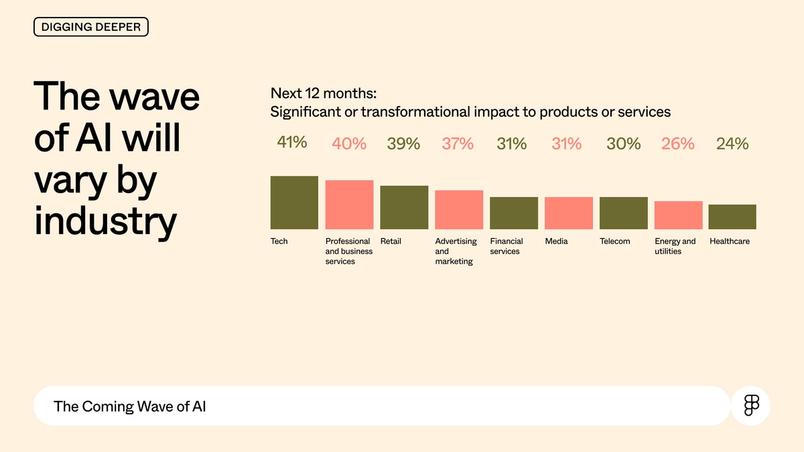
When considering the products and services you interact with daily, you might wonder how AI will change the screens and software—like Figma—that you use. Many respondents in technology (41%), professional and business services (40%), and retail (39%) anticipate significant AI-driven changes to their products and services.
Beyond tech, you rely on a number of other industries and institutions to keep your life balanced. Respondents in healthcare, energy and utilities, and telecommunications—representing large aspects of our lives—anticipate the least impact from AI on their products and services in the next 12 months compared to other respondents. To unlock AI’s full potential, we need to turn our attention to how industries like healthcare and utilities will need to evolve, too.

The winding path to useful AI
With all the buzz and recent developments, leaders are eager to incorporate AI into their products and services, putting pressure on teams to churn out features without time to think and tinker. As one livestream attendee says, “Everyone who is rolling out AI is doing it in the exact same way, so it’s a race to the bottom.” The pressure to make AI work is pushing teams to the limit, similar to AI feature fatigue. Another participant says, “I’m happy you mentioned the fatigue may be coming more from team members—I can definitely see that in my own organization. There is so much available out there, and very little in terms of best practices since the wave of AI is so new. [It] can be a little overwhelming to wrap your head around.”
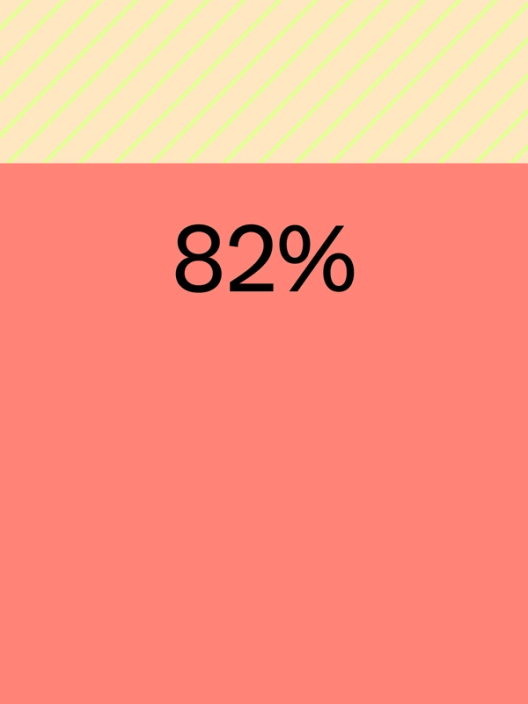
While our survey found that only ⅓ of all respondents are proud of the features and products they’ve launched so far, it’s a different story for those building AI into the core of what they’re shipping. Eighty-two percent of respondents who say AI plays a role in essential areas of the product are proud of what they’ve shipped, much higher than the rest. This group feels their use of generative AI has made their products more valuable and useful, but conversations reveal it hasn’t been easy for them.
Zan Gilani, a Principal Product Manager at Duolingo, describes working on eight generative AI products last year that didn’t quite land—until the team made the ninth one. The feature—conversational speaking with an AI partner—is currently in beta testing. What sets it apart? Zan believes that rapid iteration and lightweight prototyping are the key to its success, along with the fact that this feature solves a real user need.



I’m astonished by how many ideas are coming from programmers, subject matter experts, and stakeholders. The last three AI projects I’ve designed have come from stakeholders outside design.
Will AI live up to the hype? Not all technologies—even the most hyped ones—are truly transformative, at least not in the ways we might predict. The ones that are have something in common: teams who see the potential and are willing to experiment until they get it right. This kind of work is underappreciated, and it often requires pushing against disillusionment, embracing failure, and knowing when to put your head down and keep building. But on the other side, it might just be worth it.
Special thanks to Shane Johnston.