

How to build a resilient design team



In an environment that demands speed and agility, how do you build a team that’s resilient to change, no matter what’s around the corner?
Share How to build a resilient design team
Hero illustration by Erica Horiuchi
Design teams today are facing a lot of new challenges. The tech landscape is evolving rapidly, companies are lean and moving fast, and AI is regularly disrupting how people think and work. Designers working at scale have to absorb hundreds of inputs, requirements, opinions, and constraints, then distill everything into a product that’s simple and intuitive—all while adapting to new tools and processes.
Operating this way requires them to step outside their comfort zone, take risks, and ultimately put themselves in a vulnerable creative headspace. They need to feel supported enough to embrace this discomfort, which can be especially tricky to foster in a high-pressure environment.
This is the everyday reality you’ll navigate as a design leader. It’s an ever-changing, unpredictable role that requires flexibility, compassion, grit, and taste. There’s no playbook for how to survive and thrive in this job (I know, because I tried in vain to find one), but thinking from first principles and questioning your own assumptions will get you far. I'll share some tips I learned for building resilient design teams at Figma, Twitter, and 37signals—amidst the best and worst of times.
1. Start with team health
Nobody brings their ‘A’ game when they’re stressed, overworked, burned out, or afraid to speak up about problems they’re struggling with. The most successful creative collaborations come from building trust between team members and establishing a shared mission to do their best work. You ultimately need a kind, fearless crew who will always level with each other—but without making their critiques feel personal or belittling in any way.
Here’s how you can proactively foster an open and transparent culture:
- Provide a variety of synchronous and asynchronous venues for people to weigh in. This way, the loudest voice in the room doesn’t always dominate decisions.
- Encourage open sharing and discussion at all phases of a project. It should be equally acceptable to share a rough sketch or the final_final_final design.
- Check in regularly with 1:1s, career discussions, and team feedback surveys. By proactively checking on team pulse, you’ll be in the loop early when problems are lurking.
- Be realistic about bandwidth. Ensure that your team has enough time to achieve what you’re trying to do. Don’t set them up to fail by overcommitting and then struggling to deliver.
- Model vulnerability and candor yourself. Be honest when you don’t know the answer, or when you’re wrestling with a problem too.


Learn more in our guide to creating a design-driven culture.
2. Encourage experimentation and shifting roles
Creative people—like designers—spike in different ways; a problem that confounds one designer might be a dream project for another. That’s why I like to be mindful of everyone’s superpowers and growth areas. If you’re leading a larger organization, group people who have complementary skillsets together so teams feel balanced, and everyone has a chance to learn from each other.
This is even more critical at a time when traditional roles and work processes are up for debate. Research, design, product, and engineering are getting closer than ever, with folks increasingly shifting across specialities and role boundaries. Encourage designers to lean into these shifts and experiment with new tools and approaches. The goal is to reorient your whole team such that it’s built to adapt, and feels excited about embracing change.
Here are a few techniques to foster this mindset across your team:
- Help designers get closer to production. Try rallying your team to do more AI prototyping and code experimentation. The faster designers can evaluate real things, the quicker they’ll make good decisions—so this investment is likely to have a flywheel effect on your productivity.
- Create spaces for people to share their experiments and document what they learned. At Figma we have a channel called #design-wip where designers often share an idea they’re noodling on, a sketch of a design, or a functional Figma Make prototype of a product flow.
- Welcome cross-functional collaborators into your process. During design crits at Figma, designers often invite their cross-functional collaborators to participate, bringing in fresh perspectives and fostering a more inclusive workflow.
- Parallelize execution and invention. You need to keep shipping, but you also need to reimagine how your work will evolve along with the shifting tech landscape. Make space for these efforts to happen in parallel.
3. Treat craft as a differentiator
In an increasingly crowded market, building useful, well executed products will set you apart, increase user loyalty and advocacy, and drive growth. This is especially true in enterprise spaces, where large-scale software often treats craft as an afterthought.
But even when everyone agrees craft is important, other pressures inevitably get in the way. Great execution requires thoughtful attention to detail—and that means some projects might take longer or require hard trade offs, like prioritizing UX refinements instead of adding more features.
It’s also common for craft and quality to slip through the cracks when you’re moving fast. Teams might not bother to hone the visual consistency and clarity in an interface, and you’ll end up with a lot of design debt that drags down customer satisfaction. That’s why you should regularly encourage teams to cut scope instead of cutting corners. It’s so much better to ship a well considered, tightly scoped solution instead of a half-baked, more ambitious one. If you get the balance right, you’ll deliver impactful work at a reliable cadence, and your team will build more credibility along the way.
Here’s how you can evangelize craft across your organization:
- Aim for excellence in craft—and communicate this widely. Create a shared understanding of what great craft looks like for your product, and then continually reiterate it to your team. It helps to document specific examples of going the extra mile with UX details, showing a before and after of how you improved rough spots, and explaining which surface areas are the most critical to prioritize.
- Use metrics to demonstrate how better design translates to business value. If your team simplified a complex workflow and improved the conversion rate, make some noise about it. If you added a delightful detail that improved customer goodwill, use that as qualitative evidence of brand value.
- Show that design quality can accelerate engineering efficiency over time. With well-built, reusable design components that are aligned to code, teams can move faster and focus on building more novel things.


Read Linear co-founder Karri Saarinen's 10 rules for crafting products that stand out.
4. Build bridges across the org
As a company scales, care for great products often gets overrun by organizational bureaucracy. Teams start shipping the org chart by narrowly focusing on their own incentives, rather than thinking about the greater good. You might also see attitudes like “that’s not my problem” sprouting up, or designers reusing poor UX patterns because someone else on another team set bad precedent.
As a design leader, you have to actively defend against this tendency. Keep an eye out for inefficiencies—like projects with too many ambiguous meetings, teams working in isolation towards similar outcomes, or areas where people are struggling to align with each other. Then, create space for those people to talk. Sometimes a new Slack channel, meeting, or short proposal for operational changes is all you need to open up communication and resolve the issues.
Here are a few tricks for avoiding org chart myopia:
- Share your thinking, not just deliverables. Use async walk-throughs and project recaps to broadcast your progress and lessons learned across the company. Try recording Loom videos, or make simple slide decks for easy consumption.
- Run regular cross-functional workshops. Host sessions where designers can present recent work and pose open questions to partners outside their immediate team. This works well for regular feedback, visibility, and improving alignment.
- Set up tiger teams. Sometimes you need to move quickly on a problem that requires experts from across the company to contribute. Set them up for success by explicitly bringing them together as a formal working group. If it works out, then the experience can help inform your future org design.

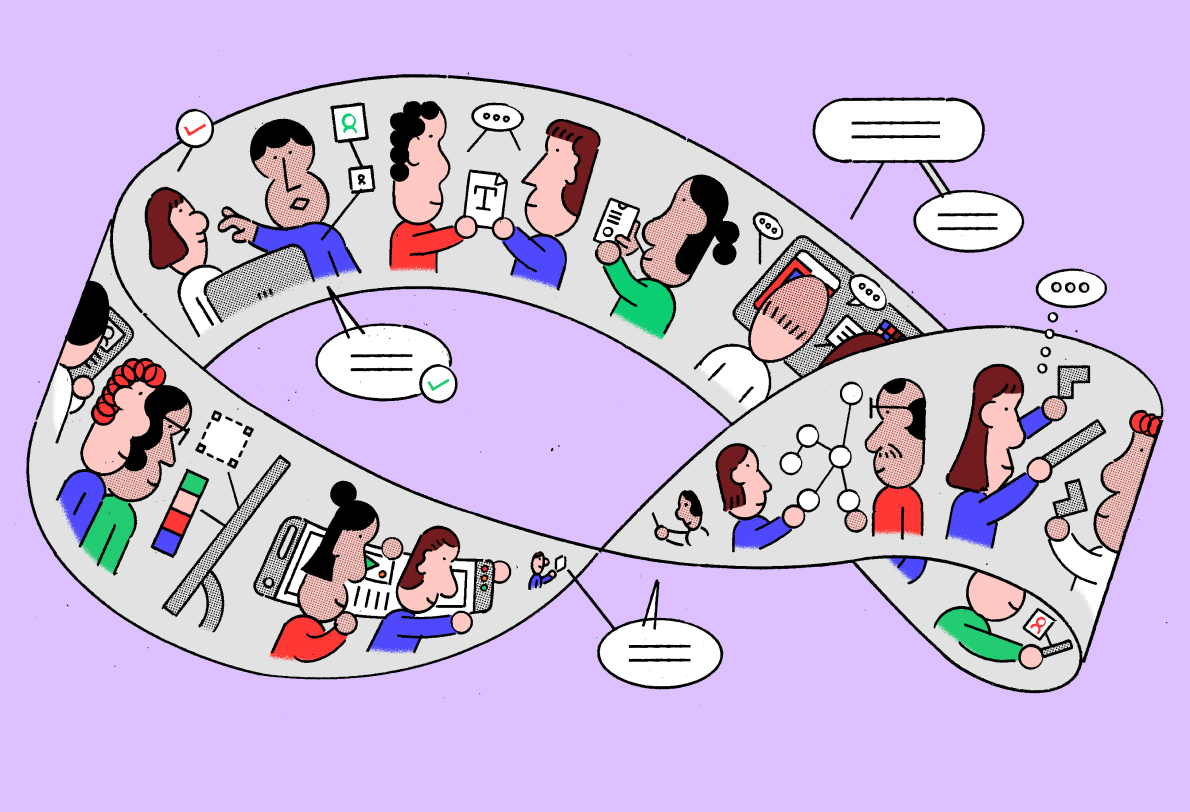
Learn how to align incentives and break down silos between teams in our guide to redefining handoff.
5. Be judicious about process
Change is hard, and macro uncertainty can leave teams feeling anxious about the road ahead. To combat the feelings of risk and fear, leaders sometimes introduce new checkpoints to ensure that there’s constant oversight, review, and approval on everything.
While these steps are certainly useful in moderation, too much process can also have the opposite effect of turning creativity into a dull factory environment. The sweet spot is just enough process. You have to trust everyone to make good calls and bubble up challenges as they arise. Design projects usually don't happen in a straight line—sometimes people need to wander for a while until they finally land on the right solution. Leave some space in the process for this to happen, so it doesn’t feel like a mistake whenever it does.
To support more autonomy, coach designers to develop an editorial sensibility about their work. That way, instead of constantly checking in for direction and permission, they’ll start to self-edit and drive decisions more independently. Then they’ll lean on you for support and refinement instead.
Here are a few prompts to use as a jumping off point:
- Which decision would you make if it was entirely up to you? This prompt encourages a stronger ownership mindset, and builds confidence in making calls.
- How would you explain this concept to a user? This framing gets teams out of their internal debates, and ensures the design is simple enough to communicate in plain language.
- How does this proposal support our business? Designers sometimes forget to evaluate their ideas against company goals. This nudge helps more projects get a green light to proceed.
- How might we simplify it? Now that they have an idea, edit, edit, edit.


The team at Duolingo takes a thoughtful approach to process, guided by the company handbook. Learn more here.
6. Scale with intention
Company growth is a good thing—adding more products, people, and teams proves that you’re working on impactful projects. But undisciplined growth without a strategy can introduce just as many problems as it solves. If you aren’t set up to work together effectively, you’ll end up with directional confusion, awkwardly structured teams, and redundancies across the org.
There are a few simple tactics to avoid this common trap:
- Only hire when you truly need it. Just having some open headcount doesn’t mean you should immediately try to fill it. Make sure you have a clear plan for what a new person will bring to the team, and what they’ll focus on for the next 6 to 12 months.
- Keep a close eye on team ratios. If you hire a designer but they don’t have enough engineers to support them in building things, they’ll be stuck making theoretical vision work that never ships. In this case it might be better to defer hiring until your partners have a chance to staff up their areas.
- Treat new roles as opportunities to fill gaps. Regularly take stock of your team’s strengths and weaknesses, and tune your hiring decisions accordingly. For example, you might already have excellent visionary thinkers on the team, but low product quality—so you’ll need to hire some craft experts to improve execution. Or maybe your execution is fine, but there isn’t enough bandwidth to achieve all of your goals, so you just need to duplicate what’s already working.
7. Make time for levity
Even in the best of times, design work is really difficult. One of the things I enjoy about being a manager is finding ways to ease the pressure during particularly stressful moments. Whether it’s making a terrible pun in Slack, starting a meeting with a five-minute icebreaker, or celebrating after a big win or shipped feature, it’s so important to lighten the mood once in a while, and give people chances to build human connections with each other. If you can bring a little joy to your team, that spirit will find its way back into the work too.
Adaptability doesn’t happen by accident—it’s a product of intentional leadership, express permission, and encouraging people to continually push the boundaries of what’s possible. And sometimes it takes a bit of trial and error to get right. Every team is different, so more than anything, focus on what works for your team and their unique needs. Those needs may evolve over time, but these core principles will set you up for success, no matter what the next chapter looks like for you.