
How Headspace built an AI companion that fosters trust and transparency



Creating an AI-powered feature for mental health poses myriad challenges—especially around keeping users safe and supported. Here, the product and brand teams talk through how they built Ebb with care and sensitivity.
Share How Headspace built an AI companion that fosters trust and transparency
For millions of people worldwide, Headspace is a crucial part of daily life. The evidence-backed, end-to-end mental health app has been downloaded over 105 million times, and provides mindfulness exercises, therapy, mental health coaching, and everyday skill-building to its members across the globe. Last year, the company launched an AI companion called Ebb, which leverages conversational AI to support a reflective practice outside of therapy sessions. With many people turning to general-purpose AI for mental and emotional support, Headspace saw a need for safe, clinically sound tools that are specifically designed for that purpose. In creating Ebb, the team took a considered approach that put safety and transparency first.
Easing into the idea of Ebb
Priyanka Marawar, a Product Design Manager who was the UX Design Lead on Ebb, notes that “people have polarized views on AI, especially in the context of mental health.” There were even concerns within the organization: Lauren Allik, Headspace’s Lead Brand Designer, recalls feeling “a little uncomfy” when she got the brief. Given there was “so much ambiguity” about the project, one of Priyanka’s first priorities was to host workshops in FigJam to make sure everyone was aligned. The care taken in that earliest phase was key to Ebb’s eventual success, she says: “We could build those deeper connections between member and business objectives because we took that moment to clearly define what we were building in terms of the end-to-end experience, and why.” The team envisioned Ebb not as a replacement for human care, but as extra help in between sessions—or a tool for those who might be afraid of, or unable to afford, therapy.
We could build those deeper connections...because we took that moment to clearly define what we were building in terms of the end-to-end experience, and why.
Copywriters Crystal and Sandy tried out a range of different names—from Odom (an anagram of “mood”) to Ibo to Scribe—but struck on the name Ebb, which was approachable and pointed to the fluidity of emotions. Internal team members and user testing groups reacted strongly, too. “It was just Ebb,” says Crystal. “We couldn’t refer to it as anything other than Ebb from that point forward.”
After these workshops, the teams used FigJam to host “playgrounds” to imagine what a Headspace AI companion might look and sound like. As Lauren explains, “illustrators, designers, copywriters, animators—everyone went to their corner and explored.” One team was responsible for naming. Lead UX Copywriter Crystal Small and Senior Copywriter Sandy Sanchez chose to steer clear of feminine names, which have become a trope for AI assistants (think: Alexa and Cortana), and which they felt might entrench stereotypes around women being caretakers, and men not tending to their mental health. “We ultimately decided that the name should be a friendly entity, not quite human but human-adjacent, and not of any specific gender,” says Crystal. When Sandy came up with the name Ebb, it was a “lightning-strike moment,” she adds, and it immediately stuck.
The teams weren’t siloed for long. Headspace operates under what Priyanka calls a “build-to-learn” philosophy, so the next phase saw the brand and product teams coming together, building prototypes, and trying out different visual identities. “I’m a big fan of stress testing something before ruling it out,” says Creative Director Dani Balenson, who adds that her team tested around six brand identities. Because Ebb was a product that would live in-app, product screens were one of the earliest deliverables to test. “We used Figma to quickly skin those screens with different identities,” says Dani. Meanwhile, the product team was progressing, and both teams were sharing screens back and forth. “Figma helped us all stay connected in one place.”
Designing for trust and safety

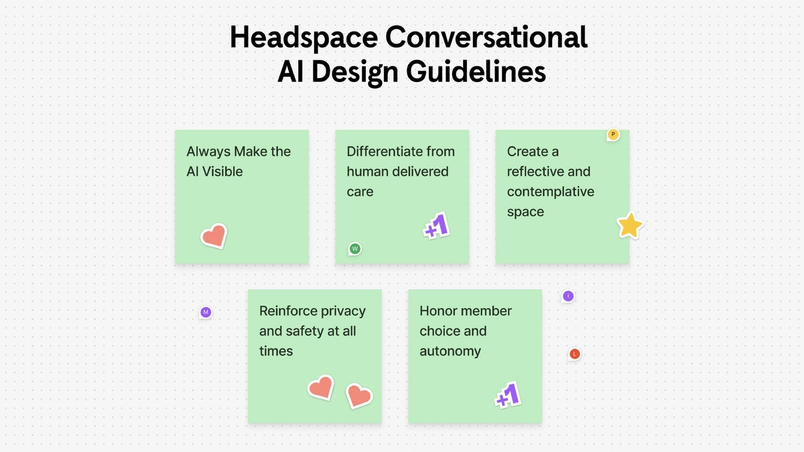

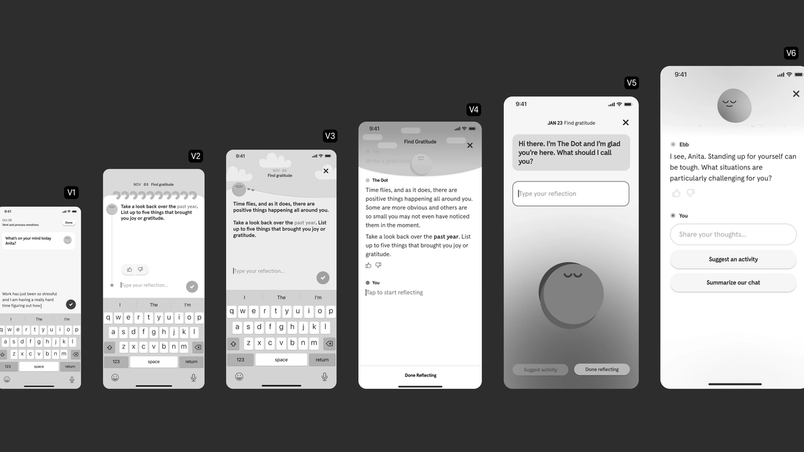
Front of mind throughout was the question of how to address barriers to adoption. Ebb had been trained by a team that included clinical psychologists, so its scientific underpinnings were robust. But from a design perspective, Priyanka saw several challenges: “How do we help members feel safe? How do we help them understand what this is, and how it can support them?” Her former colleague, Lead Product Designer Leah Braunstein, was instrumental in designing the conversational interface, ensuring that users feel safe and supported in expressing themselves, and have the agency to exit and delete a conversation at any time. Transparency was also key for preventing distrust. “We didn’t want AI to be invisible,” says Priyanka. “We wanted a member to know they were interacting with AI, not a human.”

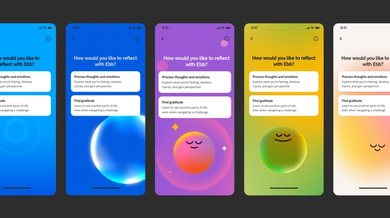

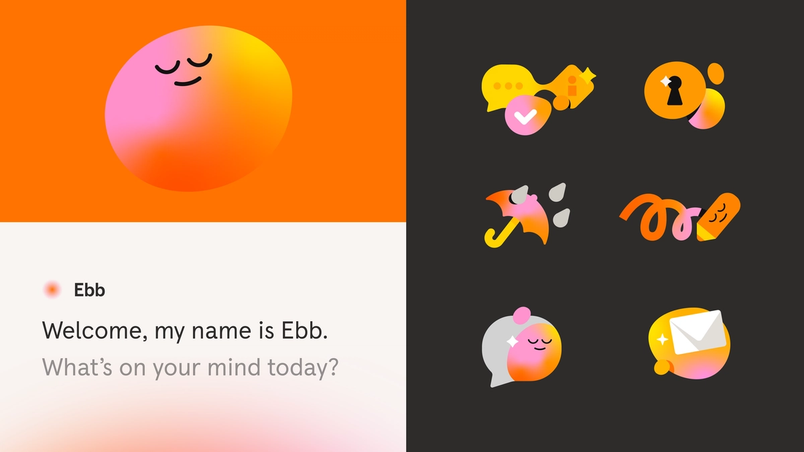
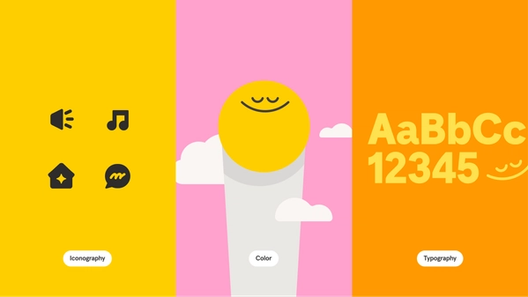
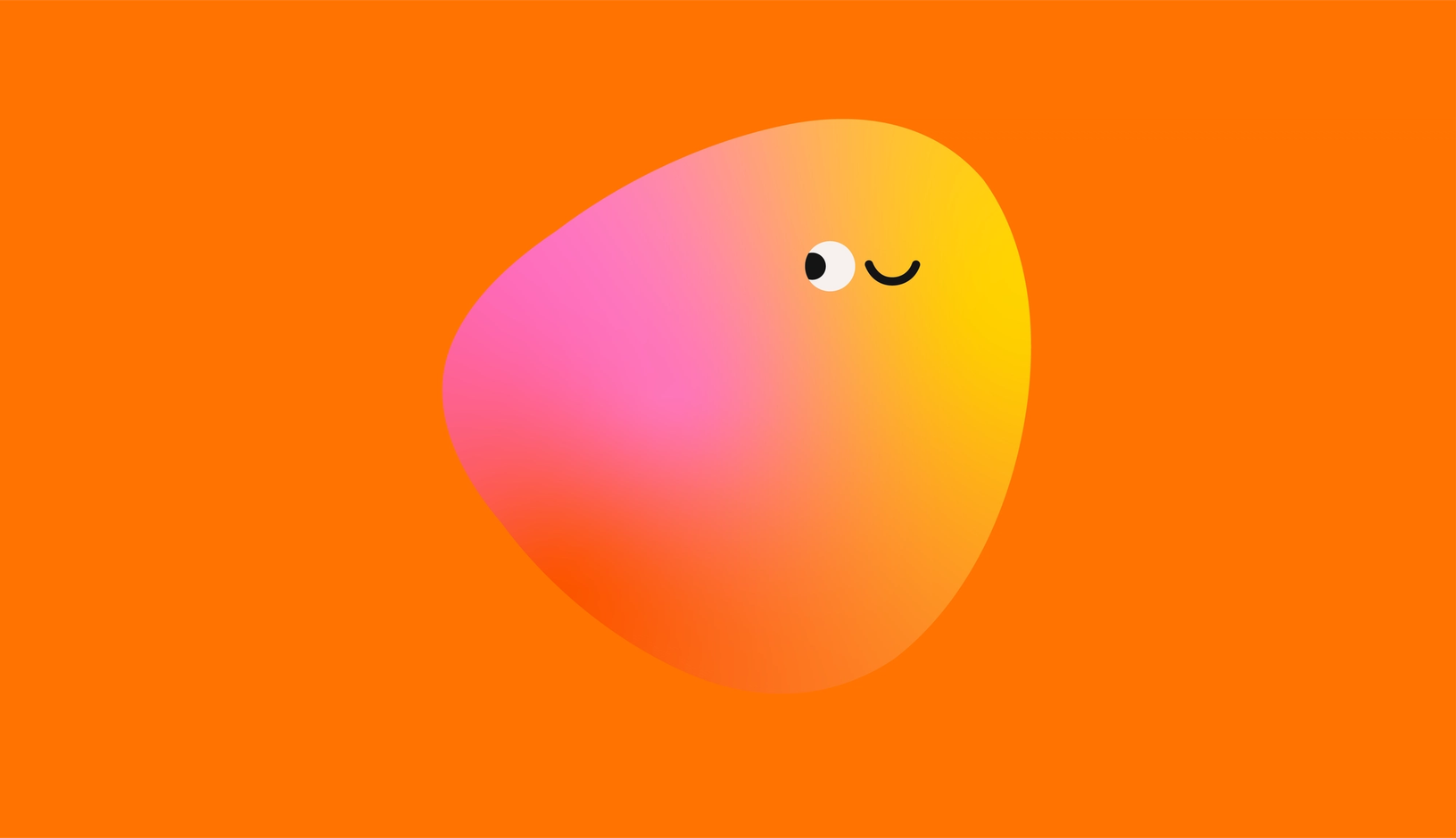
The branding had to play its part in building trust, too. While the copywriters were trying to pinpoint the perfect name, the brand team was focused on how to visualize Ebb. Members would have to come back to the companion over time to maximize the long-term benefits, so they needed to feel comfortable being vulnerable with it. To help members feel that connection, Ebb was personified as “a friendly blob,” as Priyanka puts it. It was important that the character not be too smiley, though. “You want to feel like it’s listening, but not too happy,” says Lauren, since members might come to Ebb with heavy emotions. This is also partly why, across the identity, they applied gradients, which “allow us to speak to a range of changing feelings and create a soothing environment,” says Dani.
When the name Ebb was initially suggested, it galvanized the team’s thinking, particularly around motion. They homed in on one of their favorite references, the lava lamp, which Lauren felt perfectly captured the “idea that your emotions can ebb and flow.” The final result, says Priyanka, is a motion treatment that is “supportive, but gives you space to express yourself.” According to Lauren, Figma’s motion capabilities really helped the team get to this point: “It’s amazing if you want to add references to motion.”
Testing for clarity and usability

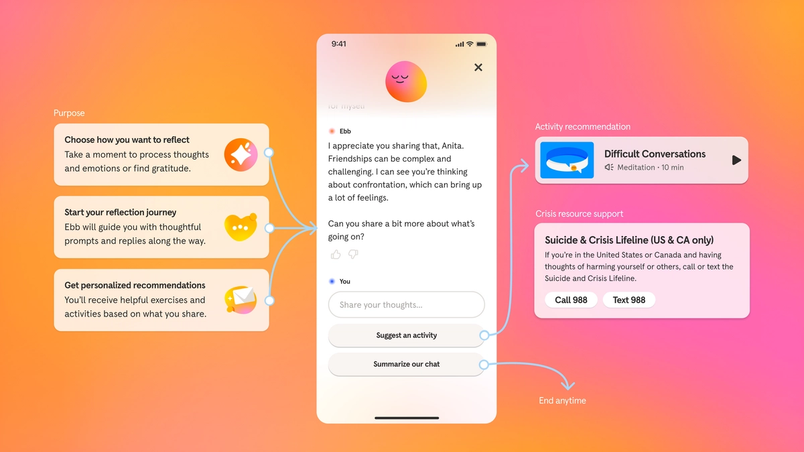
From the earliest stages of the project, the team used prototyping in Figma to get high-quality feedback on different aspects of Ebb, including the positioning and naming; the visual identity; discoverability and adoption; and the conversational interface design and usability. User testing helped ensure that members clearly understood they were interacting with AI, not a human—and helped design an experience that highlighted Headspace’s clinical expertise and stance on privacy. Meanwhile, to assess how the feature might fit into a member’s life and routines, users were given access to Ebb for a week. All of this feedback was collected through user research platform Dscout. “Figma and Dscout are the solid tools we keep going back to,” says Priyanka. “That’s the pairing for us.”
During iteration and refinement, the team used the Mirror view of Figma’s mobile app for QA-ing brand assets. “You can really take yourself into the mind of a member,” Lauren explains, “and click through the prototype to see what it looks like and how it feels.” Given most of the Headspace team is remote and spread out across the country and time zones, Figma played an “invaluable” role, says Dani. “The best way for me to leave feedback, to play in the files, and ‘show not tell’ is to use Figma.”
Telling a consistent story

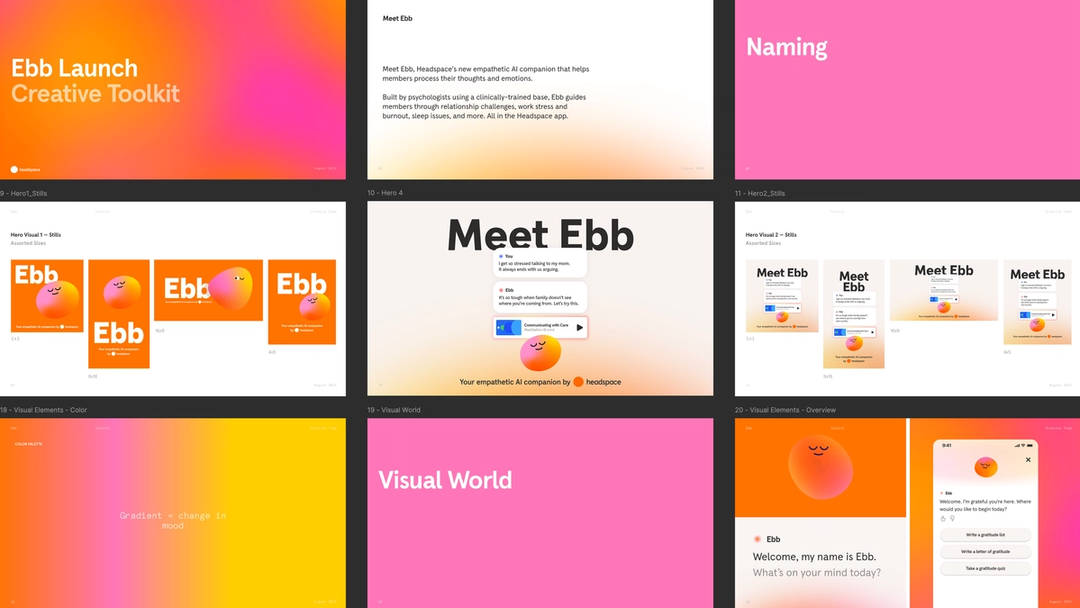
As Ebb neared launch, everyone became focused on consistency—particularly given this was Headspace’s first consumer-facing foray into AI. “We reviewed everything going out the door really closely, because that trust was so important and nuanced,” says Dani. Figma helped ensure that one unified message got out there. “Having everything in one place made it easy for me to be consistent across product screens, emails, and push notifications,” says Sandy, who was responsible for copy across these surfaces. To ensure visual consistency, Dani and her team built a “story kit” in Figma—essentially a toolkit with all the assets for the campaign, meaning designers across the company could draw from “one source of truth” when creating content.
Finally, it was time to present the Ebb prototype to the wider company. “We always use Figma to present our ideas,” says Lauren. “We were building out slides in Figma before Figma Slides even launched. So when it did, we were excited to streamline that process.” For her, the biggest benefit of Figma Slides is that she can use brand assets seamlessly and place prototypes directly into a deck without losing elements such as motion. Visibility was key to getting continued buy-in. “I think the intentionality we were putting into designing the member experience actually helped us gain trust with internal stakeholders,” says Priyanka.
A thoughtful approach to AI
In fact, “intentionality” sums up Priyanka’s biggest learning from the project as a whole. The world of AI is incredibly fast-paced, she says, but even here—in fact, especially here—“there’s value in investing in research and user testing to help us build the right thing, and design with intention.” Ebb is the culmination of extensive research, training, testing, and designing in a thoughtful manner. The result is a product that is both truly helpful for members and faithful to the Headspace brand.
Matt is a freelance writer and editor based in London, who was previously the editor-in-chief of creative media company It's Nice That. Before that, he worked at Monocle magazine, where he covered a range of topics, from business and entrepreneurship to design and retail.