
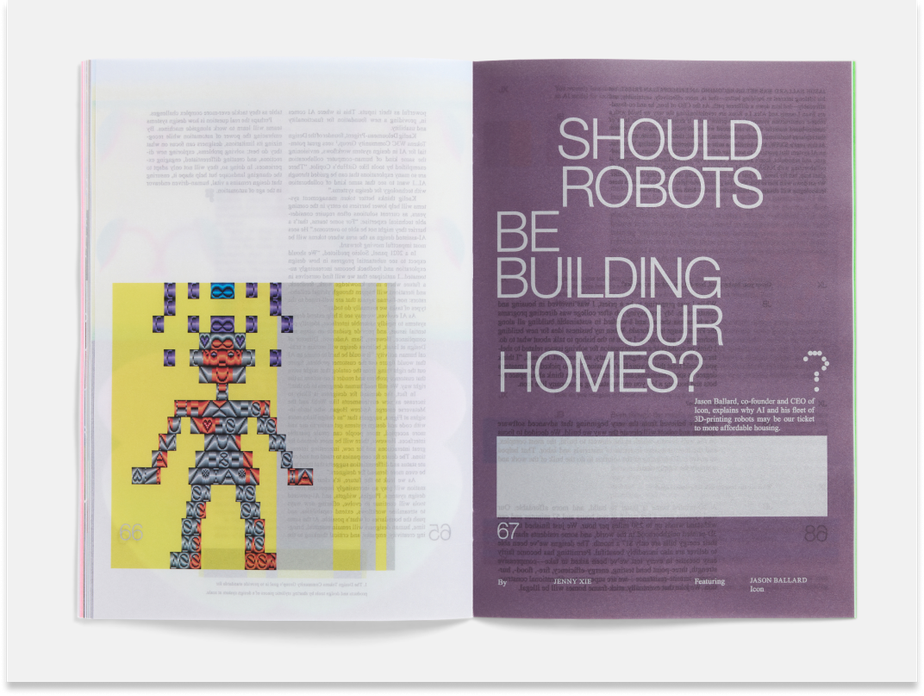
Should robots be building our homes?



Jason Ballard, co-founder and CEO of Icon, explains why AI and his fleet of 3D-printing robots may be our ticket to more affordable housing.
Share Should robots be building our homes?


Hero illustration by Lena Weber
Jason Ballard was set on becoming an Episcopalian priest, but his lifelong interest in building better—that is, more effectively, sustainably, and affordably—led him down a different path. As the CEO of Icon, he and co-founders Evan Loomis and Alex Le Roux are revolutionizing the way we build with a robotic construction system that 3D-prints walls. It extrudes layer upon layer of cement-based material that is reinforced with steel rods, creating a wall system that replaces traditional framing, insulation, drywall, sheathing, finish, and siding. At this year’s SXSW, Icon unveiled a suite of advancements including Vitruvius, an AI system that promises to someday deliver ready-to-build designs, plans, budgets, and schedules. Icon’s ambitions extend even beyond Earth: The company is collaborating with NASA to build infrastructure on the moon. It may seem like a giant leap, but for Jason, it’s just what comes of taking one small step after another. We sat down with him to talk about his guiding principles, and why he thinks these technologies will change the built environment—both on- and off-world.


Given your background, how did you end up in robotics?
While I was preparing to be a priest, I was involved in housing and construction. My first paying job after college was directing programs at a homeless shelter, and I worked in sustainable building all along the Front Range in Colorado. When my business idea for new building technologies got funding, I went to the bishop to talk about what to do. I think he could hear a sincere passion for solving issues related to shelter and its affordability, dignity, beauty, and comfort. He said, “I think you should treat this as your life’s mission.” I also picked up a master’s degree in space resources, and it turns out if you think about space robots and housing a lot, you end up starting a company like Icon.
What was Icon’s original vision?
We have believed from the very beginning that advanced software systems and robots will elevate the way we build. We decided to focus on the wall system, which is the slowest to build, the most complex, and the most intensive in terms of materials and labor. That helped us arrive at 3D-printing as the solution to do the bulk of the work and simplify the supply chain.
What are the benefits of a 3D-printed home?
A 3D-printed home is faster to build, and more affordable. Our wall systems have a fire rating of two hours and 57 minutes and can withstand winds up to 250 miles per hour. We just finished the first 3D-printed neighborhood in the world, and some residents share that their energy bills are only $17 a month. The designs we’ve been able to deliver are also incredibly beautiful. Permitting has become fairly easy because in every test we’ve been asked to take—compressive strength, three-point bend testing, energy-efficiency, fire-, flood-, hurricane-, termite-resistance—we are superior to conventional construction. We joke that eventually, stick-frame homes will be illegal.
We joke that eventually, stick-frame homes will be illegal.
You recently launched the open beta of Vitruvius. How does one go about building an AI model for architecture?
We’d been developing software systems to automate architecture since the very beginning, but we hadn’t released any products because those tasks are so computationally intensive that they didn’t always deliver accurate results. Building occurs in a certifiably complex environment. There are so many factors that can slow down a project, or make it go over budget. Permitting is hyperlocal, for example: There are thousands of different building codes in the world that are complex to parse.
Then, of course, these generative AI tools came around that could make sense of gigantic datasets much faster and more accurately than humans can. So, about two years ago we went in a generative AI data-training direction. It required a lot of legwork to purchase floor plans, building designs, permits, et cetera. We’ve assembled what we believe to be the world’s largest data set on architecture, and have been training Vitruvius to produce designs, building plans, and ultimately, robotic instructions to fulfill those plans. It seemed like a perfect application of AI to do a tremendous amount of good in the world by making beautiful, cost-effective homes more accessible.



Right now, you tell Vitruvius what kind of home you want through a chat interface, and it delivers interior and exterior renderings and floor plans. Eventually, it will include schematic designs, construction documents, budgets, and schedules. How does it work?
Our AI system is built in layers. In the early design phase, people are often responding to aesthetics, and there are some good open-source tools—mostly based on stable diffusion models—to help the tool create those renderings. Once you find something you like, you say, “I actually need four bedrooms, and I have a smaller budget, and I want it to be in the desert.” That’s where our data about environment performance and actual building codes can help produce buildable outputs.
How do you imagine different users leveraging this tool?
Even though the results are early and provisional, we released a beta version and set internal milestones to gauge whether we were on the right track with users, who are early adopters in architecture and design, and we’ve blown past all of them. Now, we’re aggressively working to bring a professional-level tool to market.
Different groups will probably use it in different ways. The professional architecture community enjoys the creative process, but they may want a copilot. Once they’ve got the concept, I think they’d love to hand it over to a system that can layer in electrical, mechanical, plumbing, and produce the permitting documents. But the wild majority of homes built in America now don’t have an architect involved at all. This tool will let those builders get tremendous architectural integrity in terms of concept and early design. We believe that 90% of design and construction should be done by either AI systems or robots, and I think that end-state is reachable in my lifetime.


What do you say to people who think that’s a sterile vision of the future?
What I would say is: Look for yourself, do Vitruvius’s designs look more or less human than the cookie-cutter developments we’re building today? You have houses designed in a spreadsheet by executives who don’t intend to live in them. Contrast that with an iPhone: A college student on financial assistance has the same iPhone that a billionaire has. Maybe that can be the same with housing. The people that have been giving us feedback have been blown away by how much the designs reflect their hopes and aspirations. So, I’m very hopeful we can steer the technologies that we develop to represent our highest and deepest values.
I’m very hopeful we can steer the technologies that we develop to represent our highest and deepest values.
You have a contract with NASA to adapt these construction systems for the moon and Mars. How’s that going?
The mechanical systems very much resemble our earth systems, but the electronics and motors have to be radiation- and vacuum-capable. What’s really different is that on Earth, we use a water-based cement. On the moon, at those temperatures and pressures, water goes straight from a solid to a gas. Plus, water’s way too valuable. So we harvest local moon dust—which scientists call regolith—analyze what it’s made of, and calibrate a laser system to melt it in a process called sintering. You can create building materials by stacking them up layer by layer, just like we do on Earth.
We recently passed a simulated test with the full system in a thermal vacuum chamber at the Marshall Space Flight Center. We’re going to do a gravitational test in the coming year. If the schedule holds, we should be attempting something on the moon in 2026 or ’27. As wild as it sounds, we have the technology to do so in our hands.
Are there plans to make these systems fully autonomous?
For the foreseeable future, there will be a human in the loop to evaluate every step before proceeding. For our new multi-story printer, Phoenix, which should be ready in 18 months, our goal is that it be a GPT-level robot. You should be able to interact with it to build what you want. We expect to have AI capabilities on the robots as well, so they should behave like one unified system from concept to build.
Right now, there’s AI over here and robotics over there, but in the future these won’t be separate ideas. In the same way that a laptop operates, there’s a certain style of software that runs on this style of hardware. My definition of a robot is something that senses its environment, makes decisions based on the input, and takes action in physical space. A humanoid thing in a trade show running on a loop is not a robot, but a Nest thermostat is. In construction, AI exceeds the computational and analytical capabilities of a human being. I think this is what’s going to allow us to have robots that meet our sci-fi expectations of what a robot should be.


Explore the rest of The Prompt, a magazine available online and in the Figma Store as a limited print edition.