






Figma’s AI report tells us how designers and developers are navigating the changing landscape.
Share Figma's 2025 AI report: Perspectives from designers and developers
Artwork by Saiman Chow
Last year, in Figma’s first annual AI report, we suggested that we were in a “pivotal” moment with AI, when AI hype in the industry was at its peak. While so much has changed in the twelve months since then, we’re still wrestling with many of the same questions. With foundational models becoming less expensive and widely accessible, there’s more competition than ever, and product builders are feeling pressure to both adopt AI into their workflows, and also ship AI-powered features at a fast clip.
This year, we set out to explore those questions by surveying 2,500 Figma users. One in three respondents are launching AI-powered products this year, up 50% from last year. They shared more than 1,000 different AI-powered products they’re working on, ranging from areas like predictive maintenance analytics to medical document interpretation.
Here, we explore five key takeaways from the report, and what they say about the state of design and development.


Agentic AI is the fastest growing product category
Text generation is the most commonly shipped product among survey respondents, while agentic AI is the fastest growing product category: Twice as many Figma users are building agentic products compared to last year. Unlike early text generating tools, which spit out copy or images with a simple prompt or generate charts with a few quick inputs, agentic AI tools can complete multi-step processes. The draw of agentic AI lies in its potential to save users time on monotonous logistical tasks and reduce costs and speed up work for businesses.


51% of Figma users working on AI products are building agents, compared to just 21% last year.
However, agentic AI tools are uniquely challenging to build. There are many variables to solve for; while text generation tools create content, agents digest, reason, and take action based on user input. For example, product builders need to consider when an agent should check in with a user, how much information to share with the user, and whether a chat interface is the most effective format—or if a series of, say, button commands would be more intuitive. These decisions require critical thinking, testing, and prototyping expertise from designers and developers.


Success requires best practices—loosely held
Agentic AI creation isn’t the only area in which human knowledge and analytical reasoning is critical. The teams that thrive are those who understand that best practices endure, while thinking critically about how to adapt them to emerging technologies. 52% of AI builders say design is more important for AI-powered products than traditional ones, while 95% say that it’s at least as important. And, they report their company leadership agrees.
Our report defines “successful teams” as a team that shipped an AI-powered project that the survey respondent says met or exceeded their expectations.
The data validates that long-held skills and best practices that so many of us have spent time honing—quick iteration, rapid prototyping, and tight collaboration loops—still have merit. Successful teams recognize that iteration is still critical to product success—sixty percent of those who were successful in building AI products agreed with the statement “We explored multiple design or technical approaches to the problem” while only 39% of those who were unsuccessful agreed. And, those who saw the process of creating a generative AI product as different from that of non-AI products were more likely to be successful. As one respondent put it, “[It’s like] running a restaurant with a menu that changes daily.” This type of push and pull in the creation phase requires skilled human input and industry fluency.
As companies continue to devote time and resources to developing the most intuitive AI tools, thoughtful design stands out as the critical differentiator in an increasingly crowded marketplace.
We are often thinking about how much we explain about what is happening behind the scenes, and how we design for AI assisted actions with a human in the loop.
Smaller companies are going all in


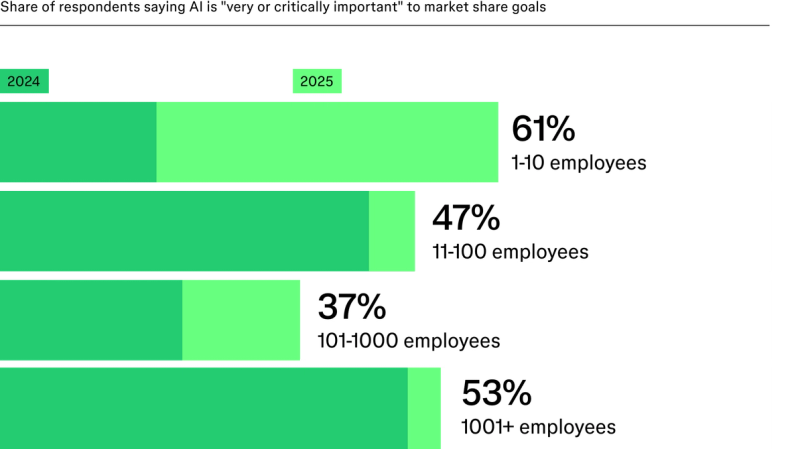
61% of Figma users at companies with 1-10 employees said AI is “very or critically important” to market share goals.
While companies of all sizes see generative AI as critical to increasing revenue and market share, smaller companies are more incentivized to go all in on building AI products. The proportion of Figma users who work at small companies and said AI was essential to their product doubled compared to last year. The belief that AI is critically important to growing market share is most prominent in companies with fewer than ten employees, who are building and integrating AI more readily into their work. Smaller companies are generally able to move more nimbly than larger ones, so it’s possible that they can learn and experiment with AI at a faster speed. There also may be a sense that AI can accelerate their business growth more rapidly, making it easier to justify a deeper investment.

AI adoption is deepening across workflows, but there’s a quality perception gap between developers and designers
While developers and designers alike recognize the importance of integrating AI into their workflows, and overall adoption of AI tools has increased, there’s a disconnect in sentiment around quality and efficacy between the two groups.
Developers report higher satisfaction with AI tools (82%) and feel AI improves the quality of their work (68%). Meanwhile, designers show more modest numbers—69% satisfaction rate and 54% reporting quality improvement—suggesting this group’s enthusiasm lags behind their developer counterparts.


67% of developers say that AI improves the quality of their work, while only 54% of designers say the same.
This divide stems from how AI can support existing work and how it’s being used: 59% of developers use AI for core development responsibilities like code generation, whereas only 31% of designers use AI in core design work like asset generation. It’s also likely that AI’s ability to generate code is coming into play—68% of developers say they use prompts to generate code, and 82% say they’re satisfied with the output. Simply put, developers are more widely finding AI adoption useful in their day-to-day work, while designers are still working to determine how and if these tools best fit into their processes.


The future is AI—but how do we get there?


78% of those surveyed agree that “AI significantly enhances the efficiency of my work,” but only 32% say they can rely on the output of AI in their work.
As teams experiment with building AI products and adopting AI tools into their workflows, they also have to contend with the dissonance between the promise of AI and its practical use in everyday work. Though AI’s impact on efficiency is clear, there are still questions about how to use AI to make people better at their role. This disparity between efficiency and quality is an ongoing battle for users and creators alike. More than anything, it highlights just how much we still need designers and developers, and their unique experience, skills, and expertise.
Looking forward, predictions about the impact of AI on work are moderate—AI’s expected impact for the coming year isn’t much higher than its expected impact last year. And, despite higher adoption, AI projects still only account for a minority of work: Only 20% of designers and developers say that the majority of their projects are powered by AI. There are also questions about quality perception to consider: Only 32% agree that they can rely on the output of AI.
And, AI builders told us many AI projects still lack clarity in purpose. Only 9% name revenue growth as the top goal; 76% cite vague aims like “experimenting with AI” or “improving customer experience.” As a result, measuring impact remains elusive.


More than 80% of both designers and developers say learning to work with AI will be essential to success in their role in the future.
Still, despite these questions around quality and impact, the overall feeling that AI will be essential in future work in some form remains. While challenges exist today, this shared view signals a future in which AI integration becomes an inherent and natural part of the product development process. What exactly that future looks like depends largely on leaders’ ability to harness the promise of AI while recognizing the power of craft and skill.
Though the usage and capabilities of AI continue to grow, there’s still uncertainty left to navigate and contradictions to wrestle with. In our full report, we dive into how to navigate the promises and open questions in this evolving space.