



At Config 2025, we were in our feelings about AI—but not in the ways you’d expect. This time around, the buzz was around building connection and care.
Share Double click: Does efficiency kill love?
Illustrations and animation by Heck Studio
Otto—beloved FigPal—makes their way to Config.
Welcome to another installment of Double Click, where our community weighs in on topics on tech and design.
Coming off the high that was Config 2025 in San Francisco and London, we're still riding the energy of the pervasive optimism reverberating around the design community—a reclaiming of what makes designers tick, how AI can augment instead of automate craft, and how good it feels to really care again. This could be summed up by the most photographed slides—from Smith & Diction’s talk “The wild west of collaborative brand design,” which boldly declared that “Efficiency kills love,” to Figma Co-founder and CEO Dylan Field’s opening keynote, which proclaimed that “Design is chasing a feeling.” Have we entered the in-our-feelings era of AI?
As Head of Design at Paradigm Yang You wrote on X, “While our industry and process is so rapidly changing, one thing is clear—craft is king, and care is the conduit.” Beyond hitting target metrics and speeding up workflows, the industry is using new tools to cultivate soul. “From storytelling frameworks to future-facing AI tools, this year’s theme hit on what matters most: making meaningful things with purpose (and a little magic),” wrote Brittany Mederos, Principal Product Design Manager at Microsoft on LinkedIn. This ethos extended to hardware, too: Take Polaroid, which has an app that offers AI-powered photography tips. “We’re anchored in the idea of people slowing down, being creative, and creating physical things that have meaning,” said Stine Bauer Dahlberg, Chief Product Officer at Polaroid in “Reinventing Polaroid for the 21st century.” In her session “How to be a robot whisperer,” Madeline Gannon, founder of Atonaton, reminded us that technology is a reflection of culture: “Automation is not inevitable. It is intentional. It reflects our values and is a result of our collective choices.” So, what are we collectively choosing to make with AI? Below, our community reveals a shifting attitude toward an accelerating technology.
Not just speedy, but special
Yes, AI can make things and help you finish tasks faster. But what’s more exciting is the way it’s allowing people to push their ideas further, regardless of their role. Christian Marc Schmidt, Founder and Partner at Schema Design, reflected on the rise of the designer-builder. “Modern tools let us go from mockups to implementation—coding, deploying, and iterating without handoffs,” he wrote on X. “We’re not just creating blueprints; we’re building solutions and evolving them with direct user feedback.”
In “Pixels and prompts: Building products in the AI era,” Figma’s Vice President of Product Paige Costello emphasized that tools like Figma Make Today we’re introducing Figma Make, a new prompt-to-app capability to help you quickly explore, iterate, and refine—whether it's generating high-fidelity prototypes or getting into the details in design and code.
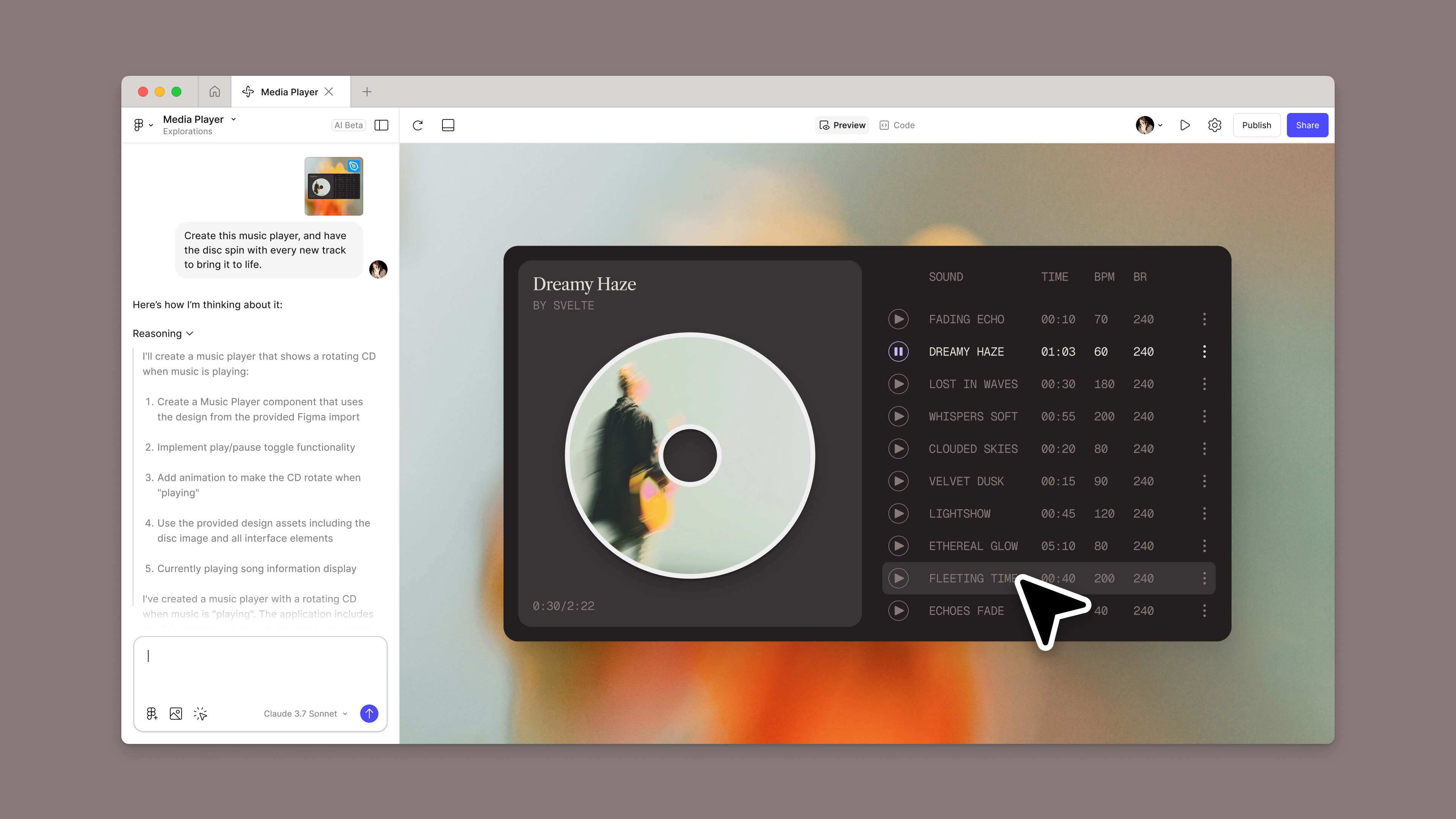
Introducing Figma Make: A new way to test, edit, and prompt designs
Overall, the theme was to not overindex on speed, but rather on how to stand out in a sea of sameness. In “Stop with the dirty tricks: Confessions of a UX skeptic,” Ningfei Ou, Content Designer at Google, urged us to think about affect, or emotion, when designing experiences. “How do you design an AI voice to sound warm, friendly, or authoritative?” he asked. “Affect is there to give context and create a vibe, which is what counts.” Taylor Barker, Senior Product Designer at Tangelo, summed up on LinkedIn: “From rewiring robots to finding beauty in discarded materials to designing a pigeon sneaker, every talk pointed back to craft—not as polish, but as care. As intention. As the quiet decision to take the long way because it’s the right way.”
Reaching minimum viable play
One approach to understanding what’s possible with AI is making space for play. In “Poetry Camera: How to fall back in love with technology,” Co-founders Kelin Carolyn Zhang and Ryan Mather explained how “minimum viable play” led them to cobble together a cardboard prototype of a camera that uses AI to print poems of what it sees.
Allowing yourself to play also means freeing yourself from having to build for TAM, or the total addressable market, said Lane Shackleton, Chief Product Officer at Coda, at “Crafting your AI play(book).” He brought up the example of “soloware,” or software built for just one person. “When the cost of building software has absolutely plummeted, you have the ability to be much more childlike and build for yourself, and that’s when you’re going to strike gold,” said Mihika Kapoor, Product Manager at Figma.
Building for yourself—and with your buddies—was at the core of “The web hasn’t happened yet” by Stripe’s Nick Jones, Design Engineer, and Devin Jacoviello, Staff Designer and Art Director. “Sometimes our best work starts off as a joke,” they shared. “Why would we expect someone to spend time on a website if we didn’t have fun making it?” Their no-holds-barred approach struck a chord with the crowd: Steven Roest, Lead Product Experience at ING, called it “goosebump coolness” and “10x creativity on steroids” on LinkedIn.
When you play, good things happen. In “Beyond agents: AI as a creative partner,” Anthropic’s Head of Product Design Joel Lewenstein invoked the power of serendipity. “I think this is part of why people are so excited about vibe coding Developers are embracing a new way of building software that’s more conversation than code. But is it more mayhem than magic?Double click: When coding becomes conversation
Tool or teammate?
Of course, an essential part of play is finding your mates. Director of Design Program Management at Etsy Steven Sommer offered a word of caution on LinkedIn, noting that there can be “an unspoken belief that [one] discipline still needs a human, while others could be safely outsourced to the machine.” We should recognize the need for nuance across all disciplines, he wrote: “We owe our teammates the same respect we demand for our own work. ‘Craft for me, AI for thee’ is not a good look.”
Others took it one step further and cast AI not just as an assistant or copilot, but an equal collaborative partner. “What does it mean when you shift from code to colleague?” wondered Baratunde Thurston, Host and Executive Producer of the podcast Life With Machines. “Because that’s the transition that we’re on: from tools to teammates,” he said in his talk, “The human side of AI.”
Joel at Anthropic also championed this idea, wondering “what AI might do with us, and not just for us.” He went on, “I think AI can and should be a creative partner. They’re central to the core creative act, and they evolve with you.” Filmmaker and CEO of Anamorph Gary Hustwit brought this idea to life with his documentary Eno, which uses a proprietary generative software to select and sequence scenes—so viewers never see the same film twice. “It’s like when a band plays. It’s more of a performance than a static film,” he said in the talk “Where design meets story.” It’s an idea born out of partnering with AI to challenge the status quo: “Just because something has always been done one way doesn’t mean it’s the only way.”
Making AI a multiplayer tool
Whether AI can be a full creative partner or not, however, it can never replace the power of human collaboration. Just as other aspects of work have become multiplayer, AI is headed that way, too. “We’re thinking long and hard about how we might be able to introduce collaboration to AI-native tools,” said Mihika. “Just as the sandbox becomes so much more fun when someone joins you to play, we would encourage you to think about how you can share the toys.”
“The AI industry likes to talk about the one-person companies that you can start now, but we wouldn’t be here if this was a one-person project,” said Kelin about her collaboration with Ryan on the Poetry Camera. “We’ve only been able to get here because of each other. And most importantly, it wouldn’t have been nearly as meaningful without everyone we’ve met along the way.”
The TLDR


On the rocket ship that is AI, having a human at the helm is critical. It seems we’re no longer interested in just steering toward faster product cycles (though those are nice, too)—we want to provoke feelings and genuine connections along the way.