How Stepstone replaced third-party software using Figma Make
How Stepstone replaced third-party software using Figma Make
The Stepstone Group runs AI-driven job marketplaces connecting jobseekers and employers across consumer and enterprise products. The design operations team supports more than 20 product designers embedded across over 40 product development teams and 400-plus engineers. At that scale, consistency does not happen by accident.
“Our ambition is to be an AI-first product and technology organization. That means creating the conditions for our teams to experiment, to challenge how they work, and to ask whether AI can make them more productive,” says Florin Ciontu, SVP of Product, Stepstone.
For design operations, that ambition has a specific meaning at Stepstone. AI is about eliminating repetitive work so designers can focus on what only humans can do, and maintaining consistency across a surface area that would otherwise be impossible to govern manually. That's why the DesignOps team has switched to an AI-first model.
"Every operational initiative now starts with 'how can we use AI to solve this?'” says Matt Gottschalk, Senior Manager of Design Operations, Stepstone.
Challenge: The hidden cost of borrowed infrastructure
Working with external vendors, plugins, and platforms is a reality for most design organizations. Each one requires time to research, procure, onboard, and maintain. For Stepstone, the costs compound on two fronts: direct licensing fees, and the time it takes the team to manage them.
However, Stepstone believes the deeper cost for design operations is less visible. When operational foundations rely on off-the-shelf tools built around someone else's assumptions, standards are based on someone else's decisions. Stepstone decided to explore a different approach.
Solution: Building exactly what you need
The mandate to experiment led the design operations team to Figma Make. What they found was not just a new tool. It changed what the team believed was possible.
The moment Figma integrated Supabase into AI platforms, the game changed. This was no longer a question of whether it was possible. It was possible now.
— Andy Gordon, Design Operations & Design Systems, Stepstone
For the first time, the team could build exactly what they needed, inside the tools they already worked in, without procurement cycles, vendor negotiations, or feature compromise. The answer to an operational challenge was no longer 'find something close enough’. It became: ‘build the right thing’.
The design system documentation platform

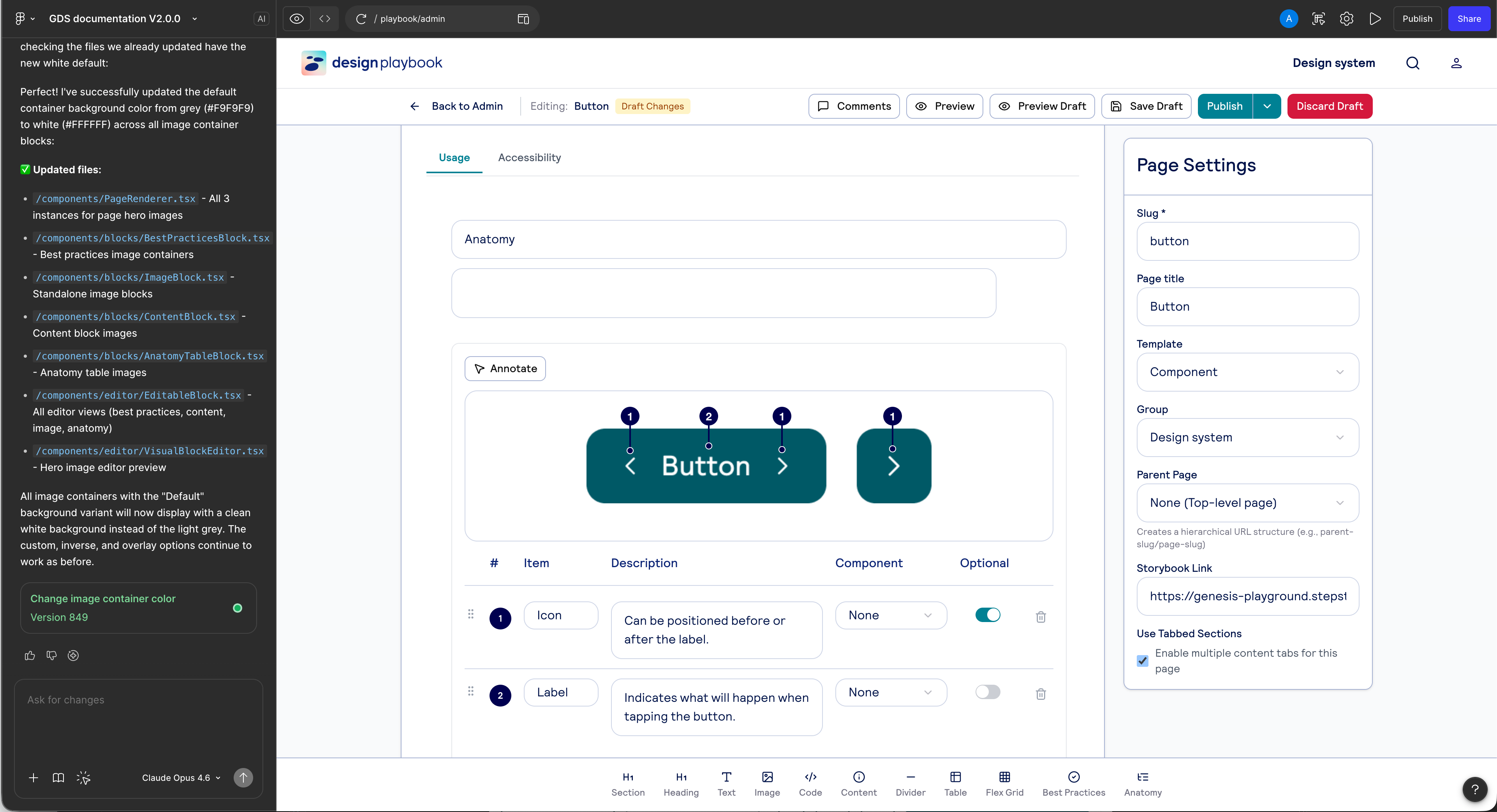
When the design systems team needed a new documentation platform, Andy explored whether he could build it directly in Figma Make. Using Supabase for the back-end CMS, he built the core functionality an off-the-shelf platform would have provided, but without the features they would never use.
“We explored how Figma Make could help us rethink how operational knowledge is created and maintained across the organization. The aim was to bring guidance from design systems, brand, content, and accessibility into a single source of truth, reducing duplication and making it far easier for teams to find and apply the right standards.
— Rachel Lumley, Lead Product Designer for Design Systems, Stepstone
The platform has two distinct layers. The user-facing side gives designers and engineers clear guidance on how to apply the design system. The admin area functions as a full CMS, with role-based workflows including admin, editor, and reviewer permissions, giving the design systems team structured control over how content is created, reviewed, and published.
“It's the kind of governance functionality that design teams typically rely on external platforms for, built entirely in-house and tailored to how the team actually works,” says Andy.
This means Stepstone could build features that genuinely support contributors, adapt quickly as guidance evolves, and maintain consistency across teams.
The translation management system
Toward the end of 2025, the team turned their attention to another problem: delivering translated content consistently across a large, multilingual surface area.
Using Figma Make, Andy and the team built a translation management system and Figma plugin that lets designers switch between languages while working. At the center of the system is an internal AI model built on Claude, trained on Stepstone's tone of voice documentation to ensure translated content is consistent with the brand's voice.

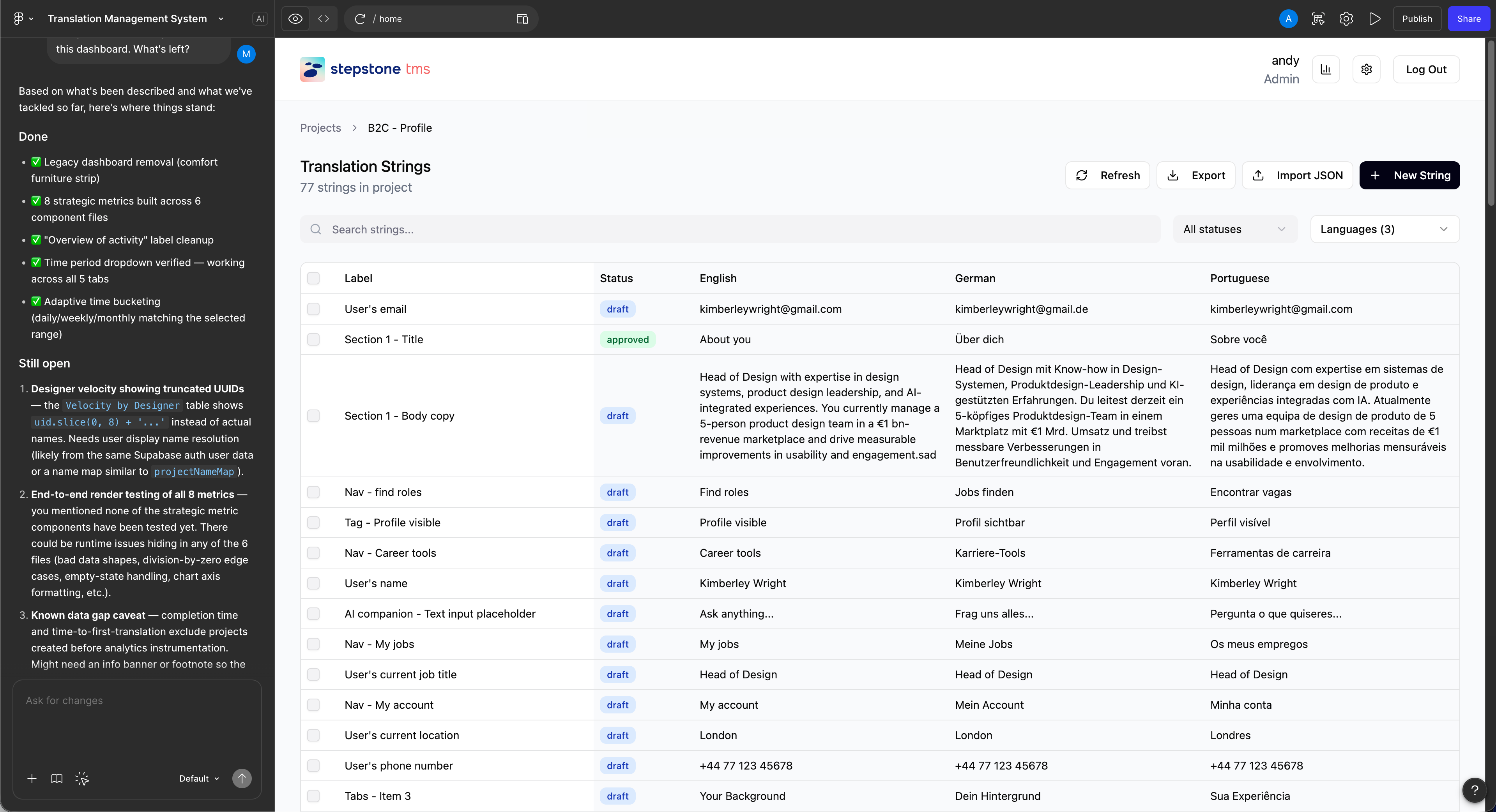
The approach began with a thorough review of existing tools on the market. Rather than replicate what existed, the team identified the strongest elements across products and built their own. Adoption, consistency, effort, and translation cost were tracked through a custom analytics dashboard, also built in Figma Make.
What's powerful is that I could tailor the dashboards to provide the level of operational visibility that off-the-shelf tools rarely give you. Being able to experiment and adjust these dashboards myself makes it much easier to continuously evaluate and improve the system.
— Mala Vadhia, Senior Design Operations Specialist, Stepstone
The real gain: speed, autonomy, and a different kind of capability
The in-house translation tool alone saves between £20k and £30k per year, money the team were able to invest in other areas. But cost reduction and budget reallocation weren’t the primary drivers.
The more significant gain was speed and autonomy. A standard procurement process for a new platform takes weeks: mapping requirements, evaluating vendors, running demos, reviewing contracts with legal, IT, and procurement. With Figma Make, that overhead is gone. The team moves from problem to solution in hours rather than weeks.
Because they build for their own workflow, they are never locked into a vendor's roadmap or pricing structure.
There might be some time later on where we can add in more features. We don't need to find some money to ask, 'Can we upgrade our package?' We just put in the additional features, based entirely on our workflow.
— Andy Gordon, Design Operations & Design Systems, Stepstone
A new standard for what design operations can do
The work at Stepstone points to something bigger than cost savings or individual tool builds.
"By combining Figma Make with our own solutions-focused culture, we've seen a shift in what's possible for operational teams within design organizations,” says Matt.
For Stepstone, that shift is structural. Design operations is no longer a coordination and procurement function. It is a product capability in its own right, one that can identify a problem and have a working solution in production within the same week.
The best design organizations are no longer defined only by what they ship. They are defined by the intelligence of how they operate. The tools they build. The standards they protect. The speed at which they move without losing coherence.
Stepstone believes the teams that lead will be the ones that treat operational excellence not as infrastructure for design, but as design itself.
To see more of how Stepstone thinks as a design organization and what they're building towards, visit stepstone.design.
See how Figma can help you scale design
Great design has the potential to differentiate your product and brand. But nothing great is made alone. Figma brings product teams together in a fast and more inclusive design workflow.
Get in touch to learn more about how Figma can help companies scale design.
We’ll cover how Figma can help:
- Bring every step of the design process—from ideation, to creation, to building designs—into one place
- Accelerate design workflows with shared company-wide design systems
- Foster inclusivity in the product team process with products that are web-based, accessible, and easy to use